


Highlights from my time at

Luma Design System
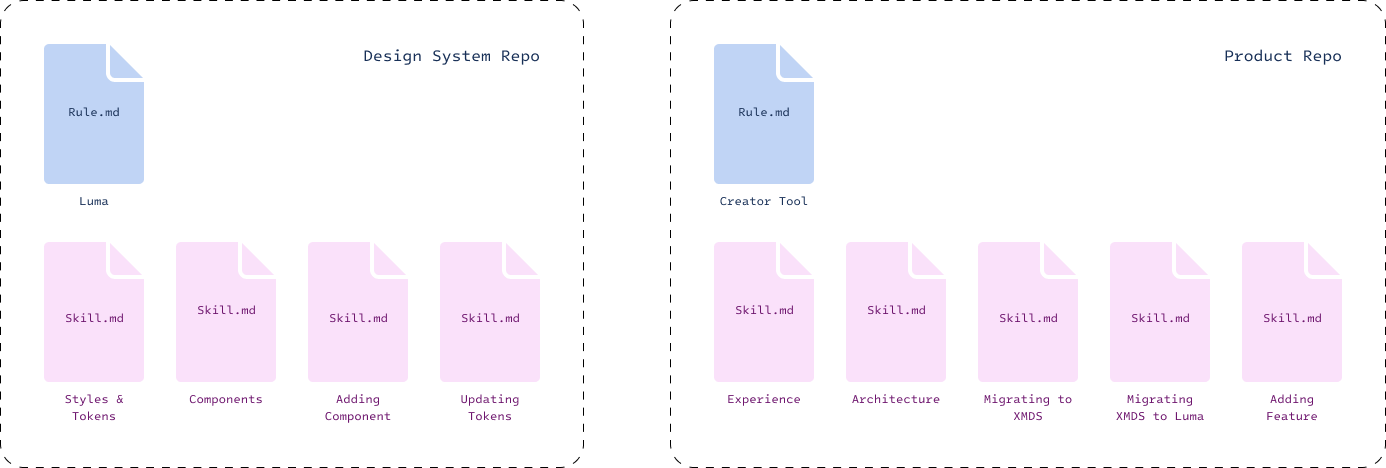
As we began expanding our Creator tooling to support agentic workflows with Horizon Studio and Horizon Create, I collaborated with the team to develop a new design system. Using Claude Code in VS Code, I established a component repository within our codebase. I then authored AI skills for creating components, implementing theming across our cross‑Meta organizational design system, and other related practices.
Timeframe
2026
Role
Product Design VI
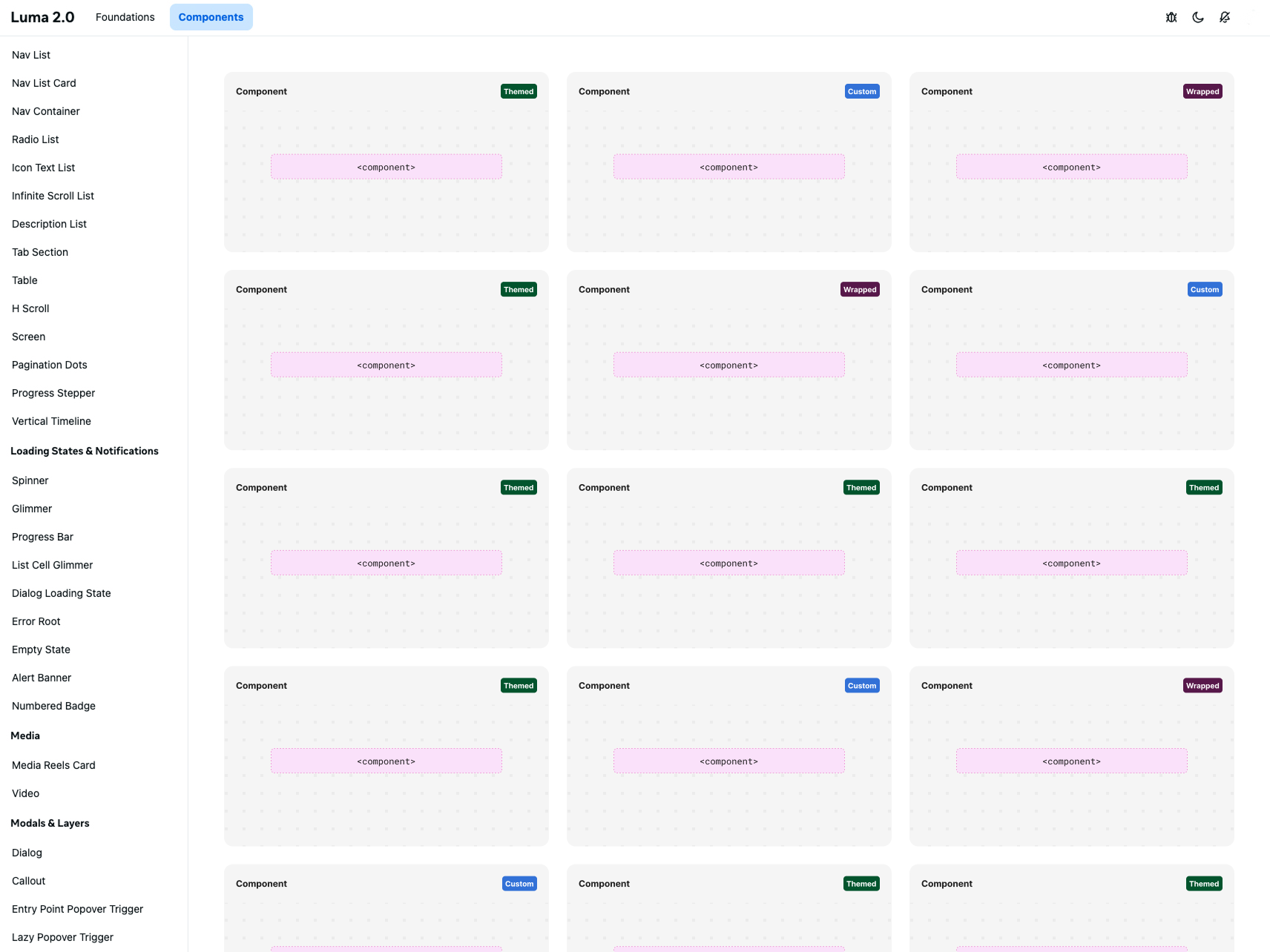
I worked with a Claude agent in GChat to plan a design-system component repo supporting: themed XMDS components (org-level), wrapped XMDS for namespacing and localized theming, and custom Luma components.
Then I used Claude Code in VS Code to generate component directories and skills, ensuring codebase standards. The skills let design peers add custom components that follow our Luma standard. And ensured new product work used the Luma system.
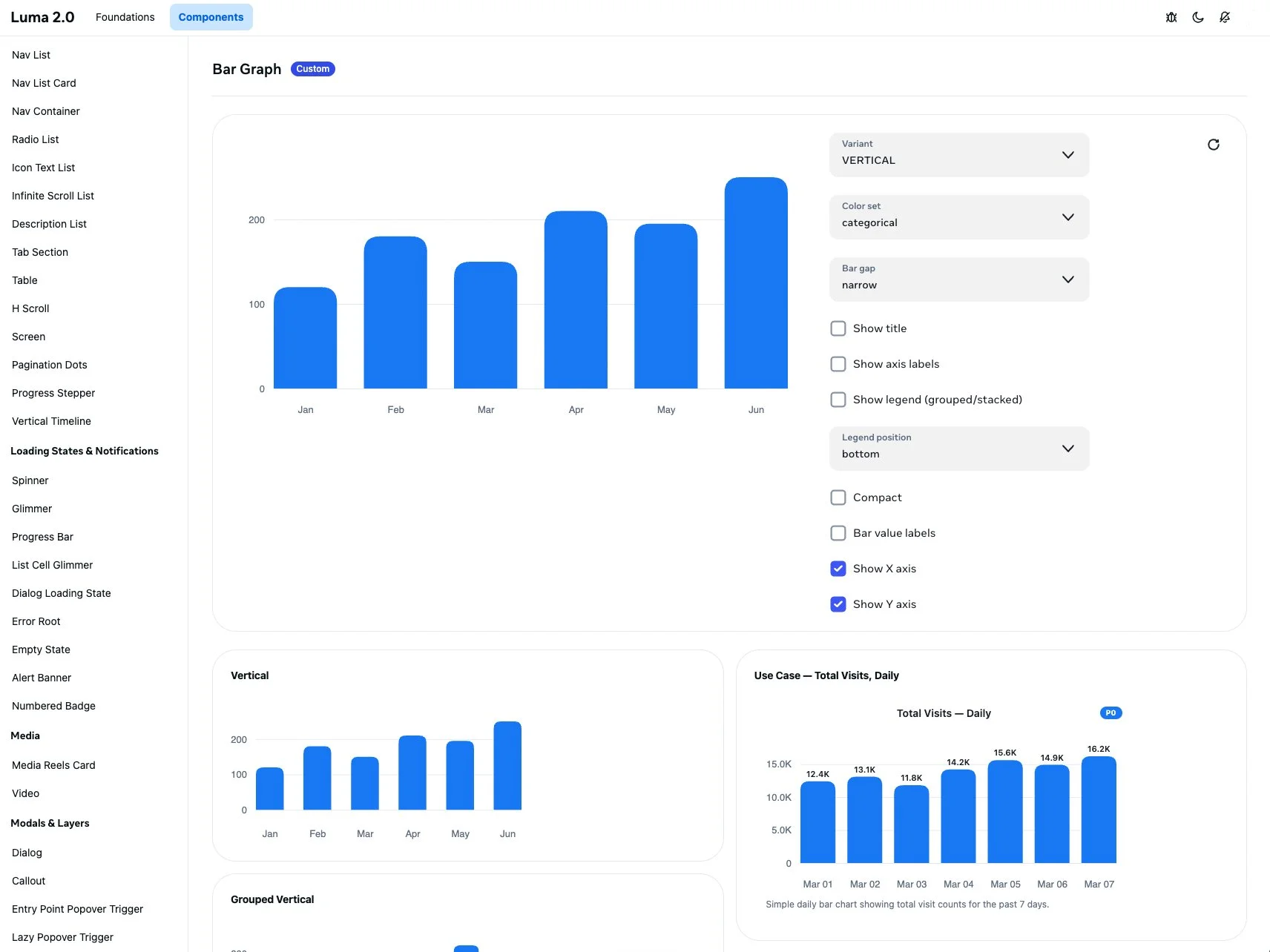
I also used the skills and existing models to construct a full set of data visualization components include bar and line graphs, sparklines, pie charts, and more. All built through an agentic plan and execution.
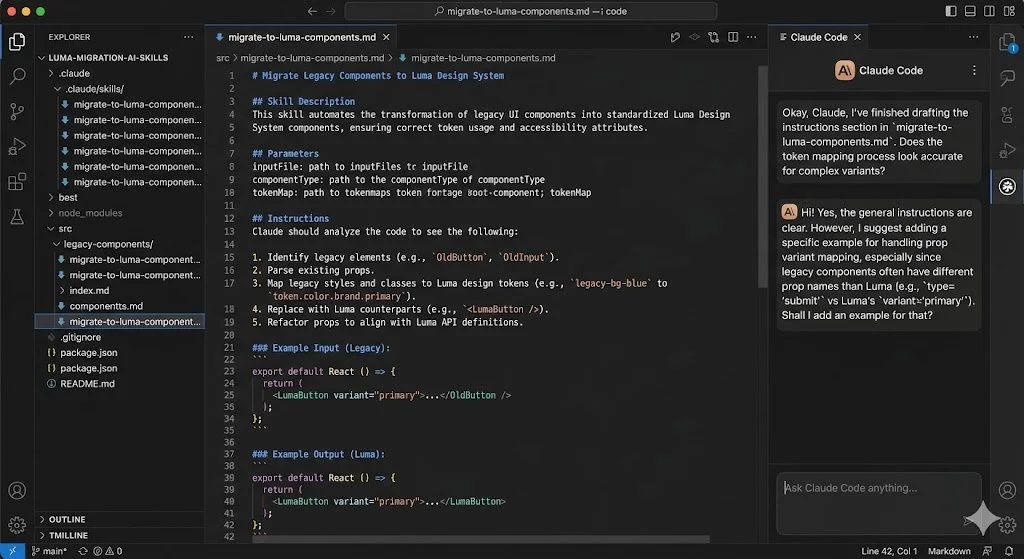
AI example to illustrate output, not representation of real output
Migrating to Luma components…
Created a migration skill for transitioning our product from legacy components to Luma components.
Agentically audited existing code and produced a prioritized migration backlog.
Collaborated with engineering to integrate tasks with an internal agent that applies code changes and generates diffs.
Then coordinated with design peers to assign tasks to the agent and manually review diffs for quality assurance.
Architecting the Luma Design System Token Infrastructure
The Challenge
Our ecosystem was fragmented, requiring a unified strategy that could accommodate different technical constraints across platforms:
Complex Web Theming: Our web platforms leveraged existing XMDS design system components, which required a robust theming strategy. Additionally, we frequently needed to build custom components with bespoke token connections.
Native Mobile Nuances: To prioritize speed-to-market, mobile development utilized direct native components (Android and iOS). Our token architecture needed to function across both platforms and seamlessly map to their specific code syntaxes.
Fragmented Foundations: A preliminary design sprint had produced a standalone design system that lacked token integration and was improperly configured to theme the XMDS components.
Lack of Cross-Platform Alignment: Web and mobile apps did not share a common design system. While full convergence was a long-term goal, we needed to establish foundational alignment immediately.
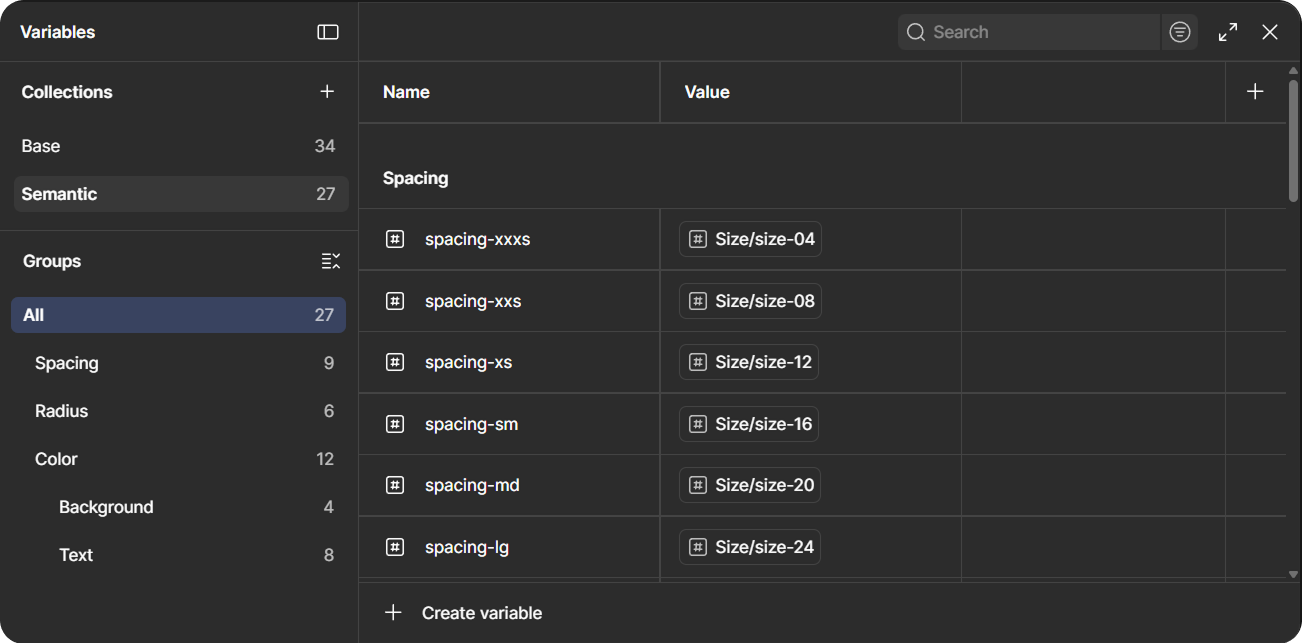
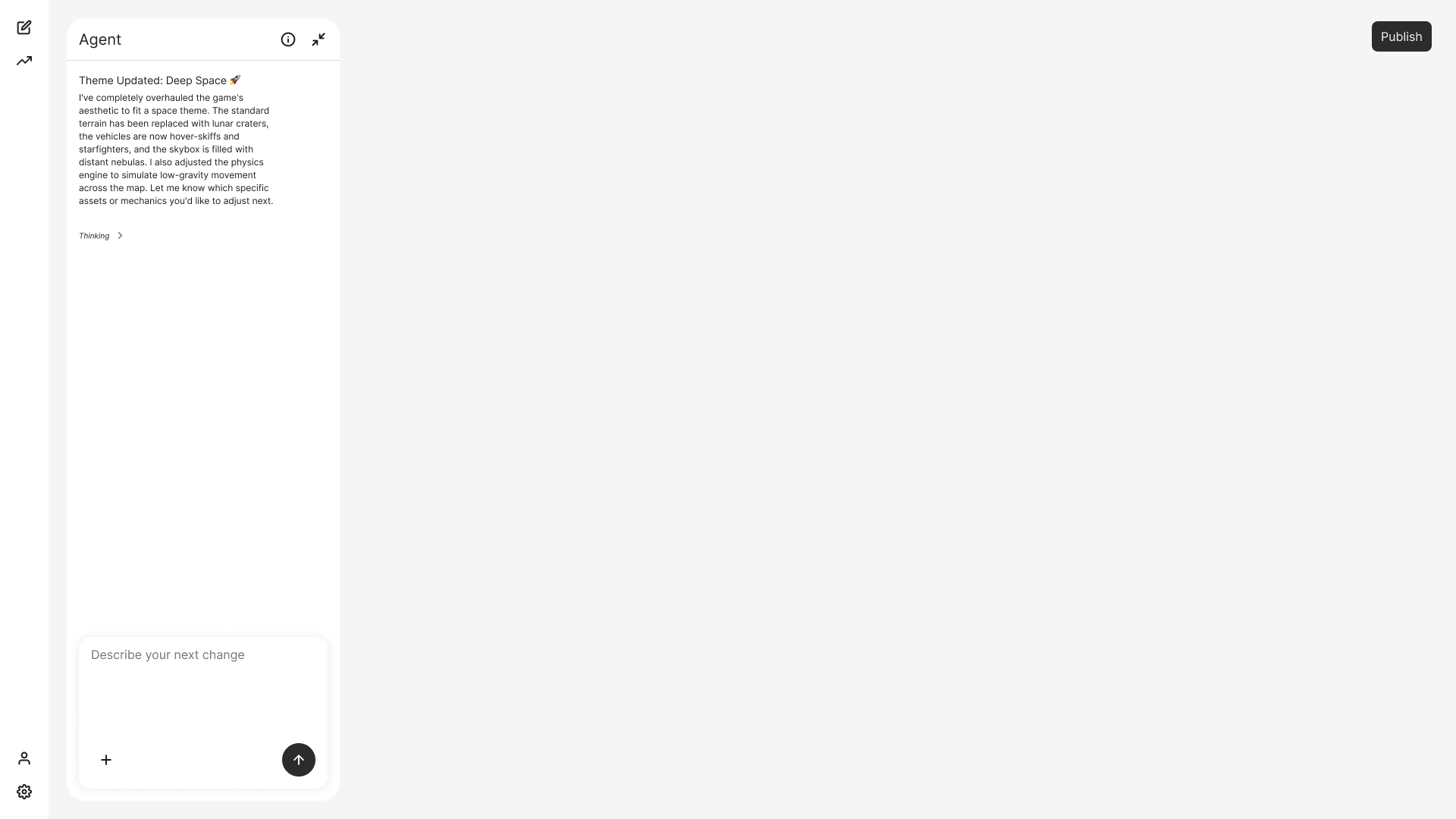
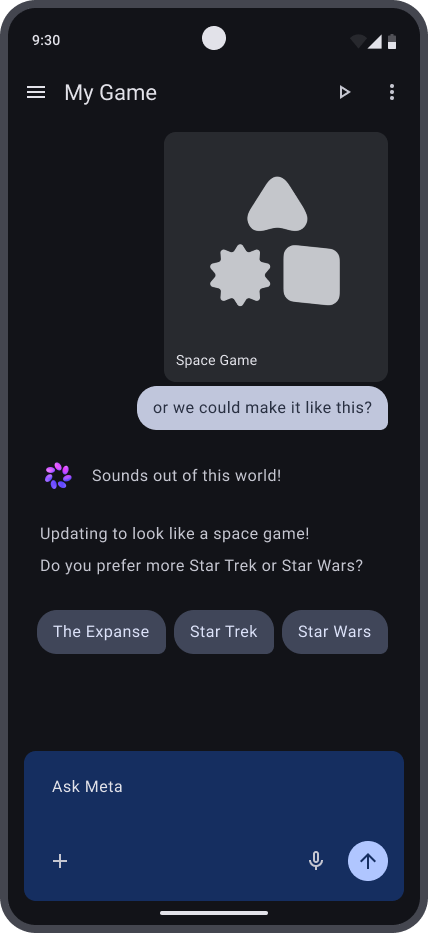
Wireframe and illustrative examples, not actual product representation
The Strategic Solution
I utilized a mix of systems thinking and agentic workflows to clean up our architecture and establish a single source of truth:
AI-Assisted Theming & Mapping: Using Claude Code, I audited and cleaned the theming tokens for XMDS, directly mapping our brand colors to the XMDS base tokens. I documented this map extensively, highlighting gaps where we still needed to define overrides.
Establishing Cross-Platform Standards: I introduced a foundational set of shared tokens (such as universal sizing values) across web and native apps to establish a common structural model. Concurrently, I built and organized the Figma variables across all our design libraries.
Agentic Token Synchronization: I worked in Claude Code to engineer a custom AI mapping skill capable of translating and re-syncing tokens across Figma, the web codebase, and app repositories. This automated the execution phase and established design as the strict, one-way source of truth for our MVP.
Future-Proof Automation Strategy: I designed a comprehensive, long-term plan to fully automate token syncing across all codebases using the Figma API. This pipeline was reviewed and officially approved by engineering for future execution.
Establishing robust AI rules and skills
I established the Rules as high-level overviews with mandatory provisions and minimal impact on the agent’s context.
In collaboration with product engineers, I explicitly define core architectural and structural competencies to give the agent appropriate structural awareness where applicable.
I developed task-specific action skills that enable agents to execute precisely according to our requirements.
The process
I gathered resources around technical architectures, design patterns, and industry practices.
Create and submitted prompt with the above resources to generate a product plan for building out a skill(s).
Then I reviewed the product plan, iterated on the agents output, making targeted tweaks to fine tune the product plan for desired goals.
In Visual Studio Code, I used planning mode of Claude Code to submit the product plan to start the generation of the skills and or rules.
I used Devmate or other agent to audit the output to verify the results, review the code changes and submit for code review.
Validated effectiveness of skills by executing a task that indexed the created skills.
I then modified skills with Claude Code to address any gaps identified during testing.
The outcome and impact
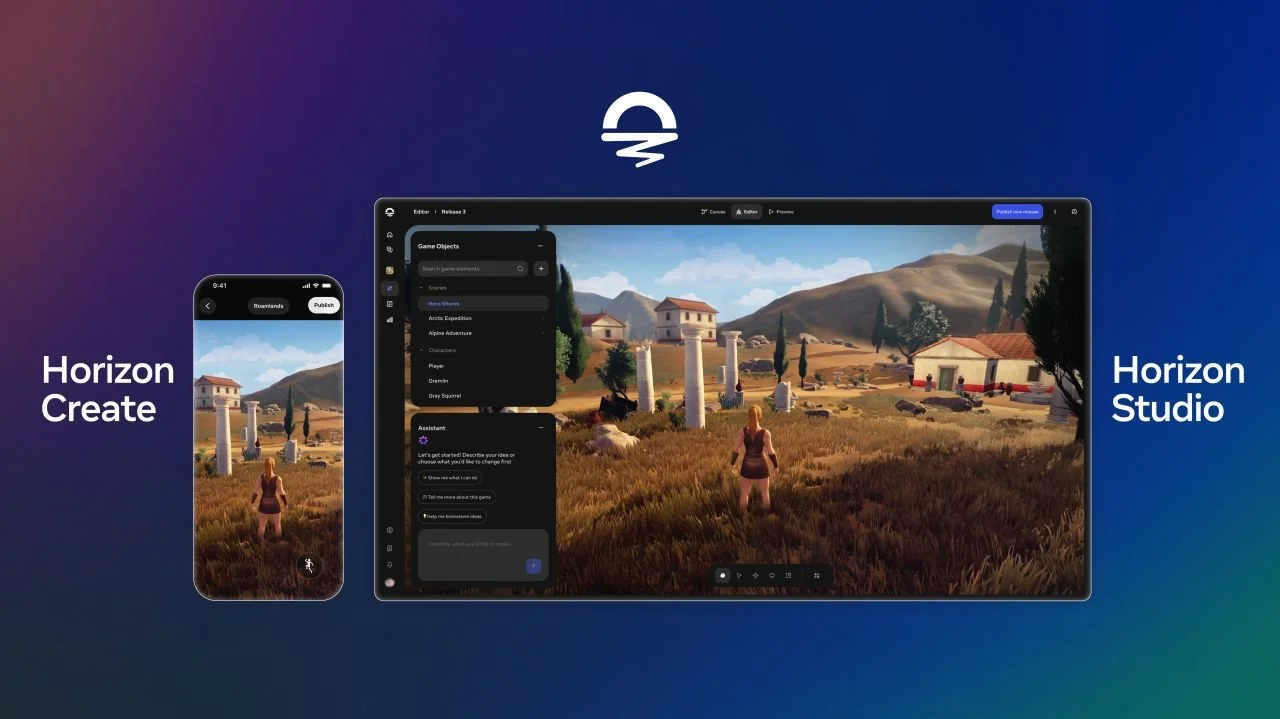
Horizon Create is the mobile app, and Horizon Studio is the desktop web tool
Over six weeks, I refined our existing design-system integration, established a new component repository featuring agent skills, configured a foundation of tokens, and enabled colleagues to build and integrate components that adhere to our standards leveraging agentic workflows.
This effort was carried out amid a rapidly evolving roadmap for agentic Creator tools and a highly dynamic agentic environment at Meta. Despite shifting priorities, our team delivered an entirely new design system—complete with P0 agent components—well ahead of the launch deadline.
Economy Product System
In 2023, I launched the Store Patterns library to create a single source of truth for designs that guided our Store experiences across VR, mobile, and select web interfaces for Quest products. When our foundational design systems were overhauled, I led the development of a comprehensive Economy Product System, co-created with and endorsed by the design systems team.
I implemented a contribution workflow and established processes that included creating a staging Figma where mock collections were curated, refined, and ultimately migrated into the authoritative Product System libraries.
Timeframe
2025 - 2026
Role
Product Designer VI

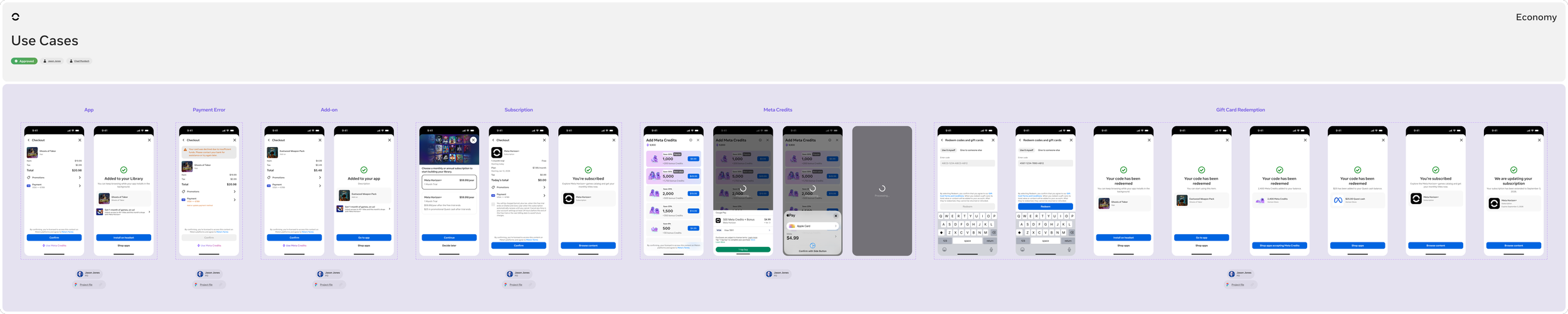
Across multiple purchase optimization initiatives and in collaboration with colleagues, I established a definitive record of the purchase experience. I completed refined Figma templates and components, and produced comprehensive documentation mapping their application across diverse use cases. Including Design POCs and links to additional Figma context.
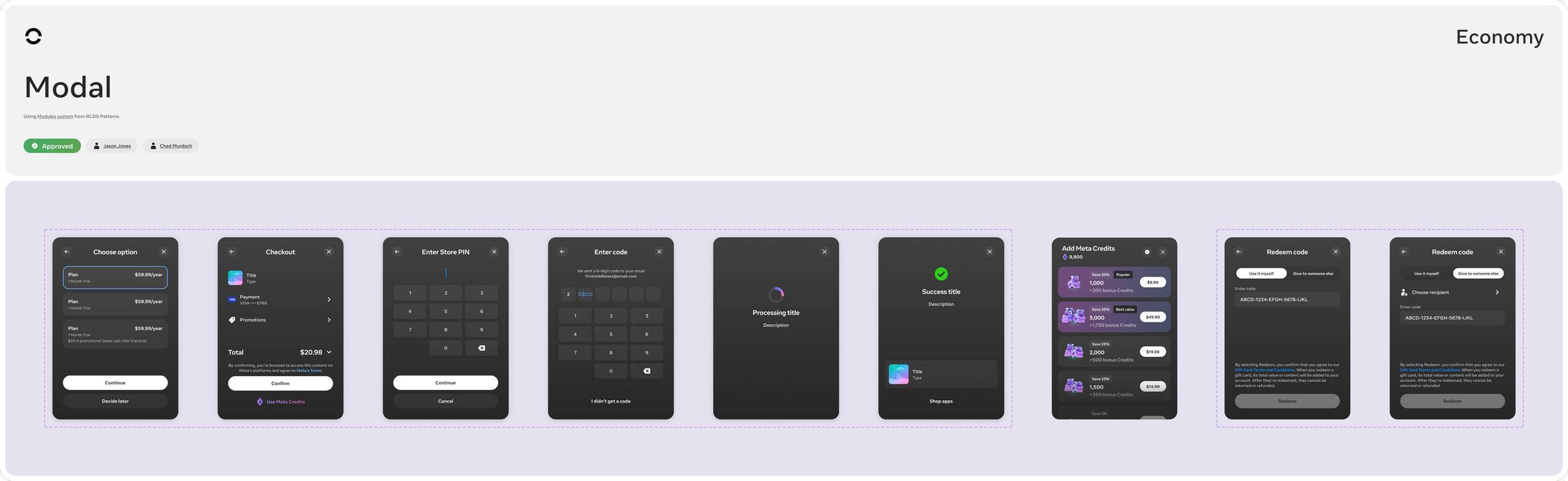
Templates
To support all the use cases, I built a set of templates of our purchase flow views that could be configured and populated with content for each use case. Enabling designers to leverage common template system for consistency and building structural logic that agents can build from.
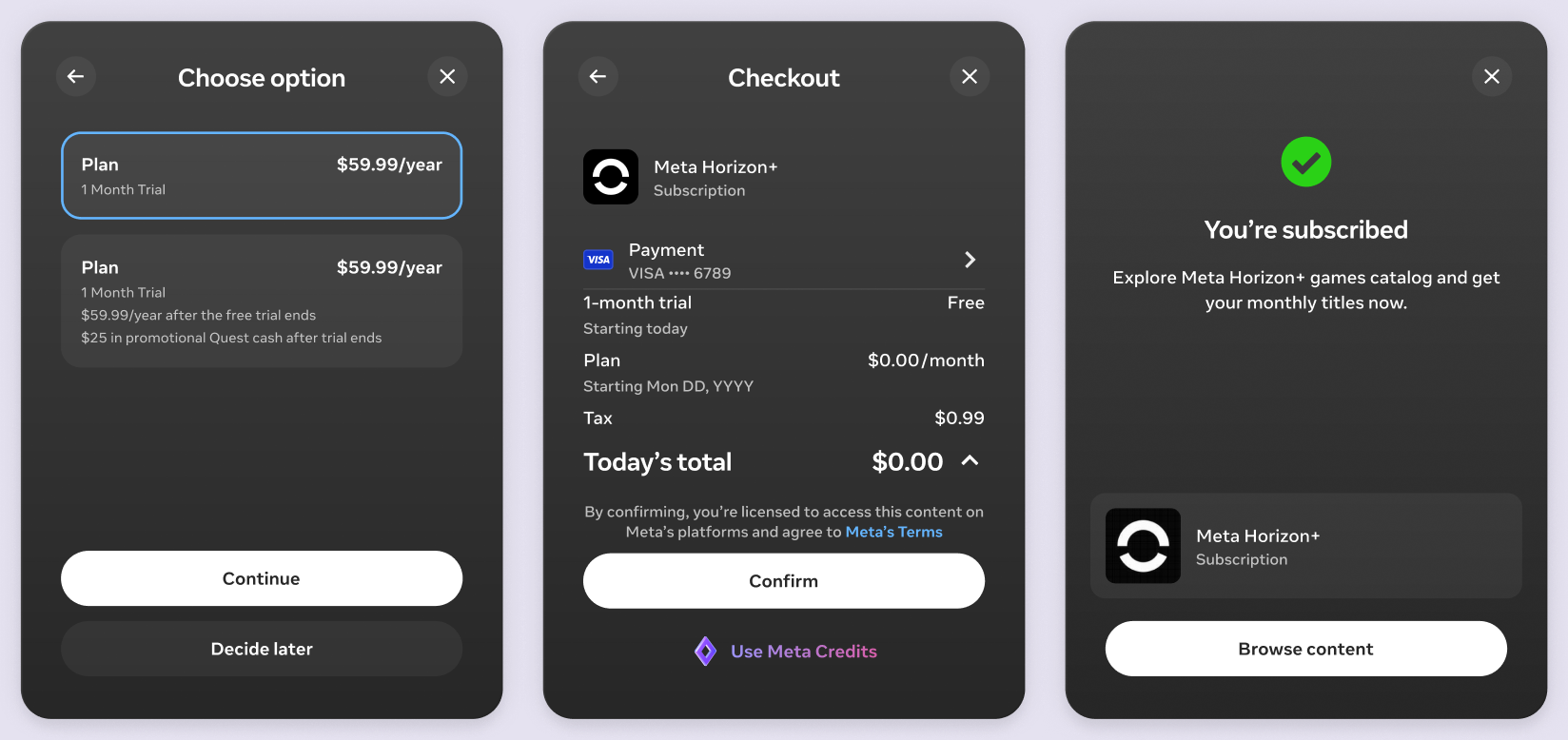
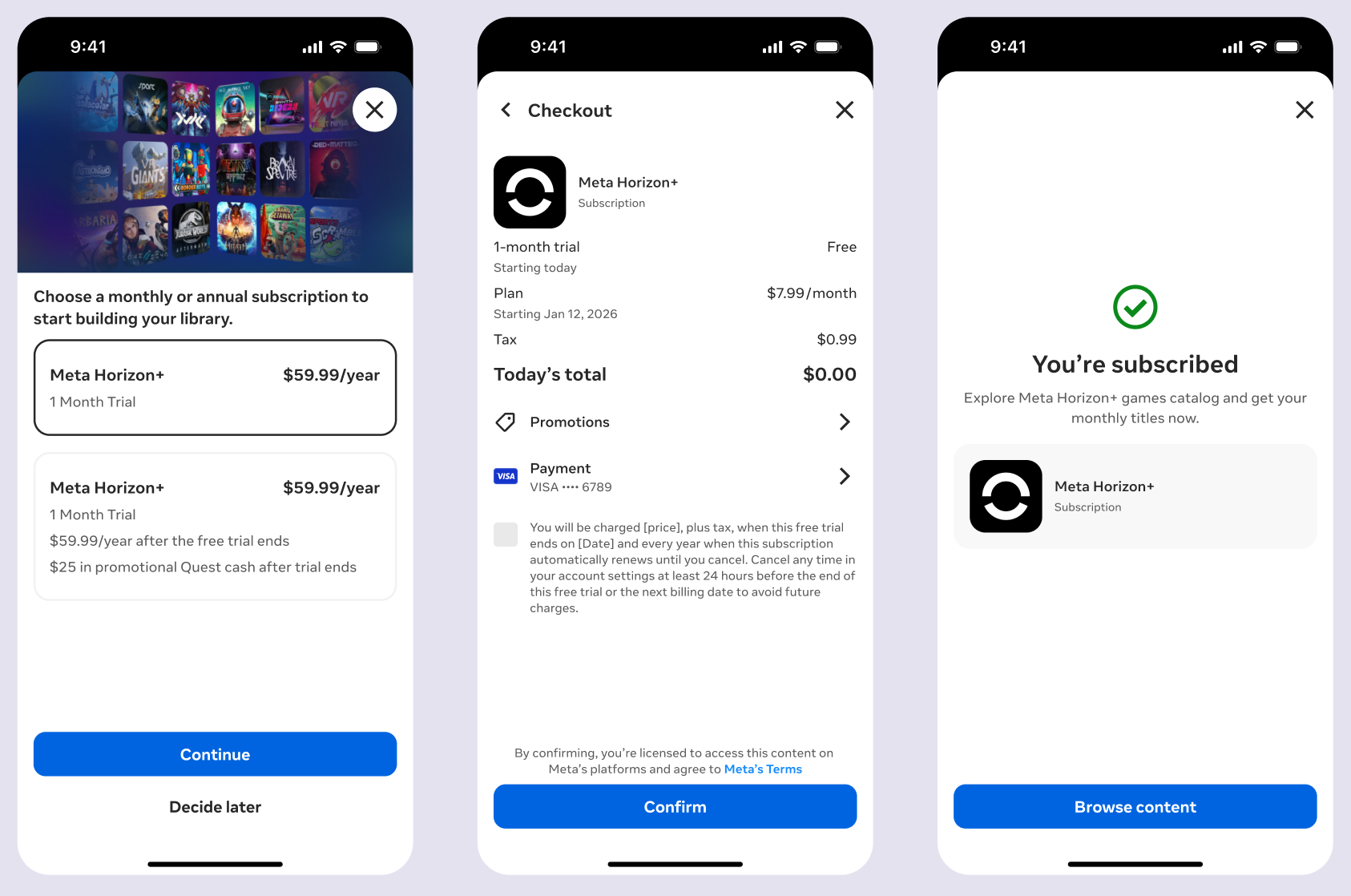
VR examples below include subscription selection step, main checkout view, PIN entry, processing, and success view. Also including Meta Credits funding menu, and gift card redemption.
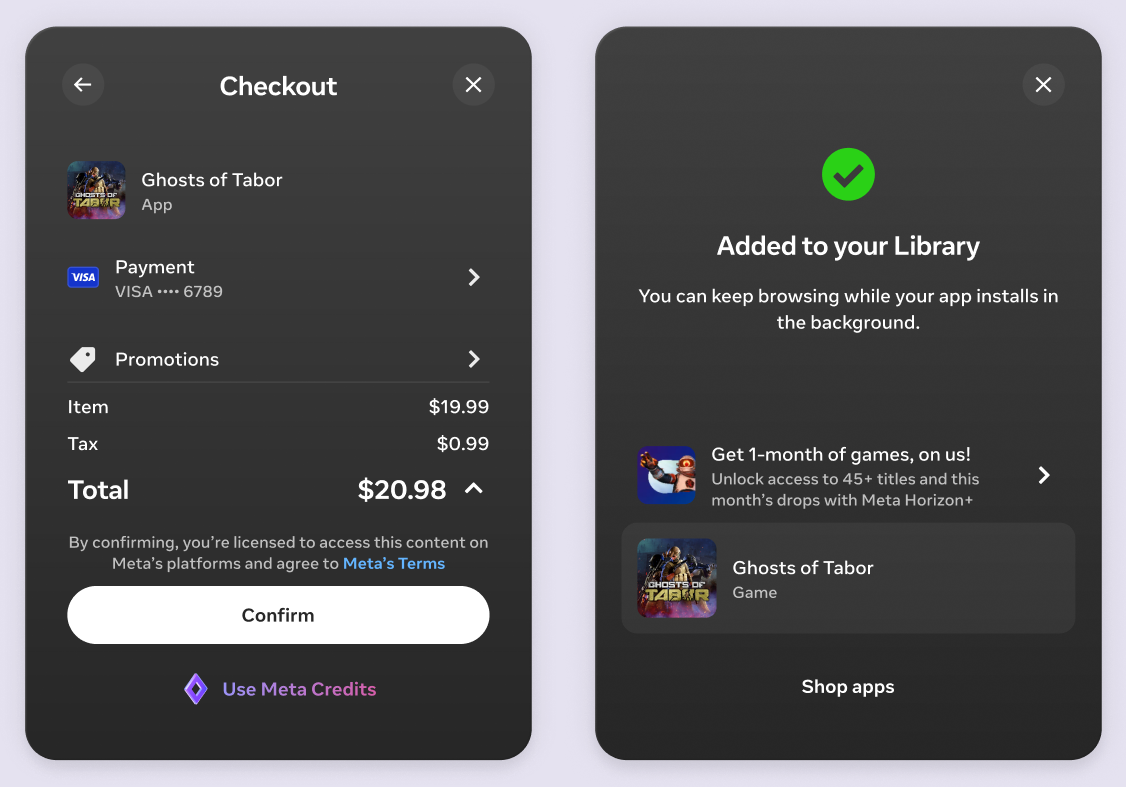
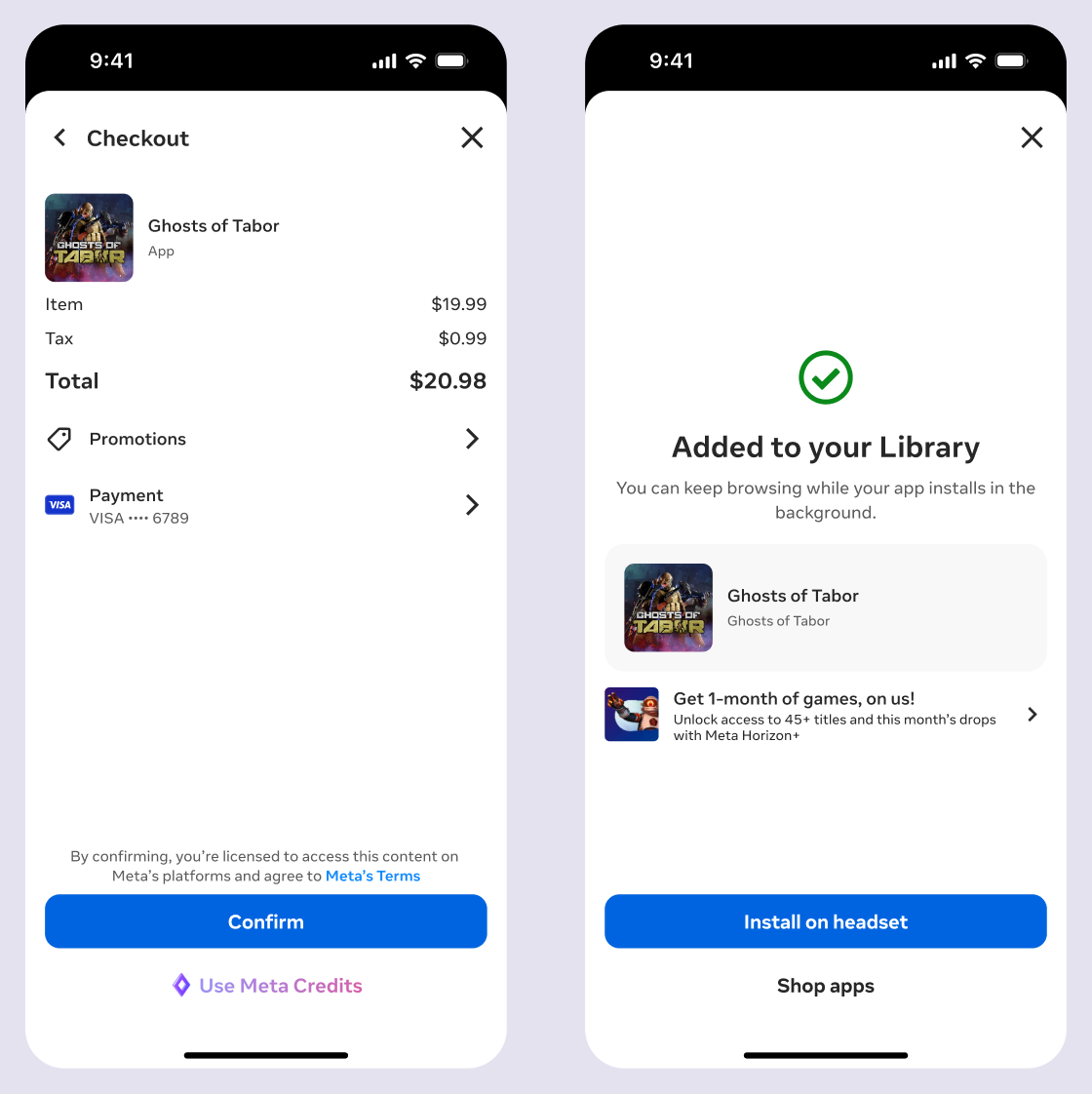
App Purchasing
Subscription
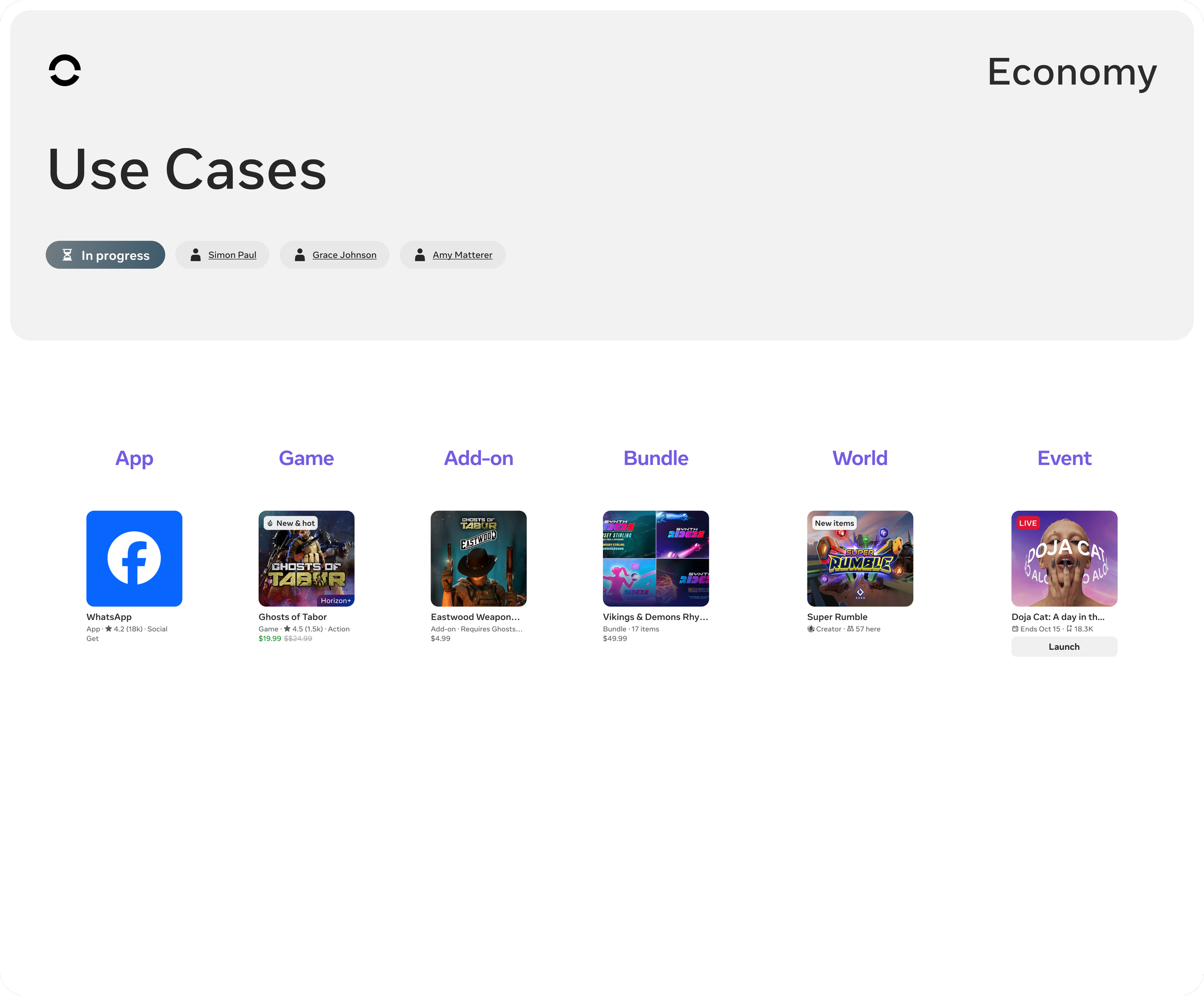
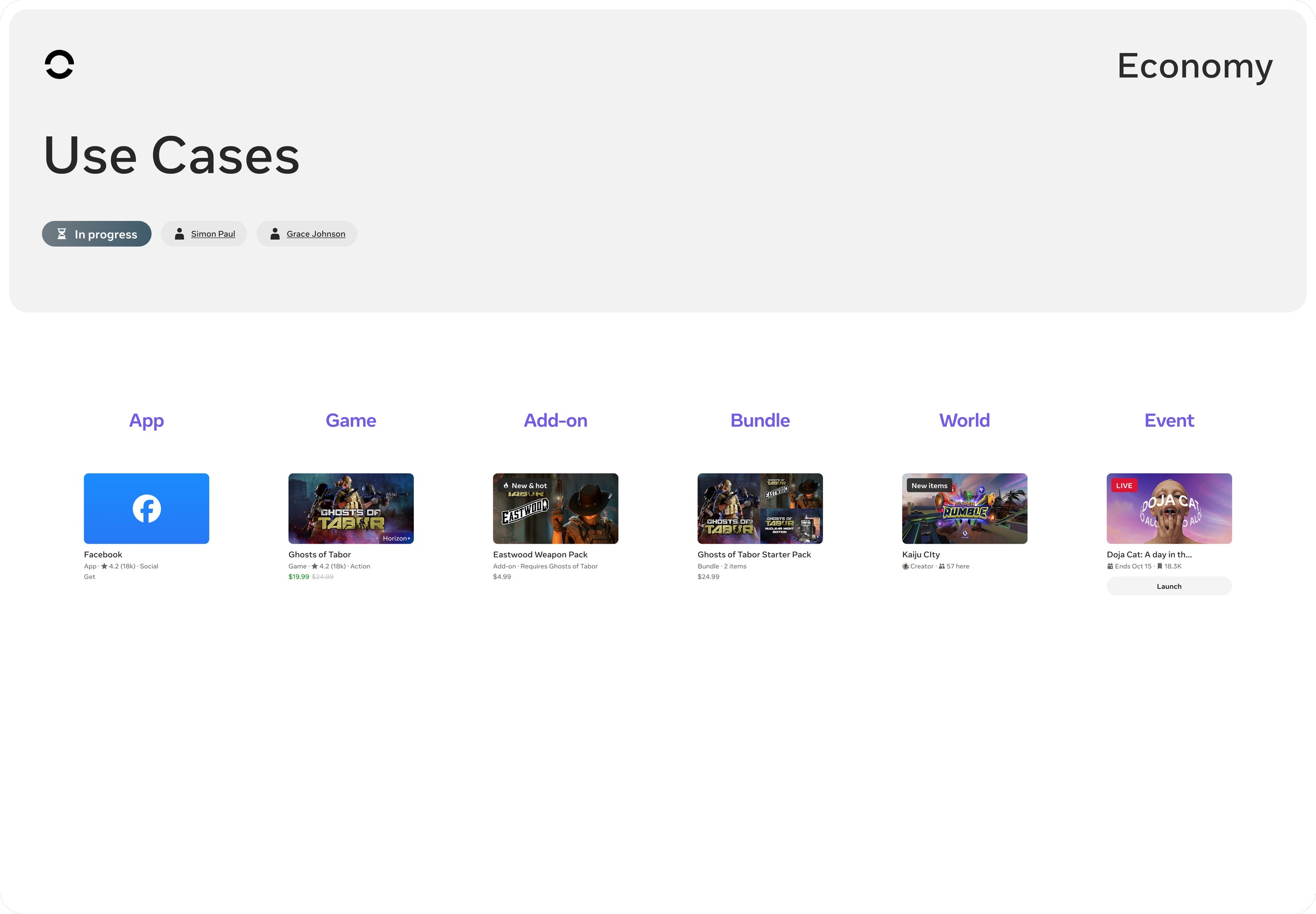
Led cross-functional teams to define a metadata taxonomy and unified product card/tile system for games, digital goods, rewards, media, and other content. Created a standardized pricing pattern and a flexible schema for dynamic metadata.
Metadata & Product Cards/Tiles
Product Detail and Store Templates
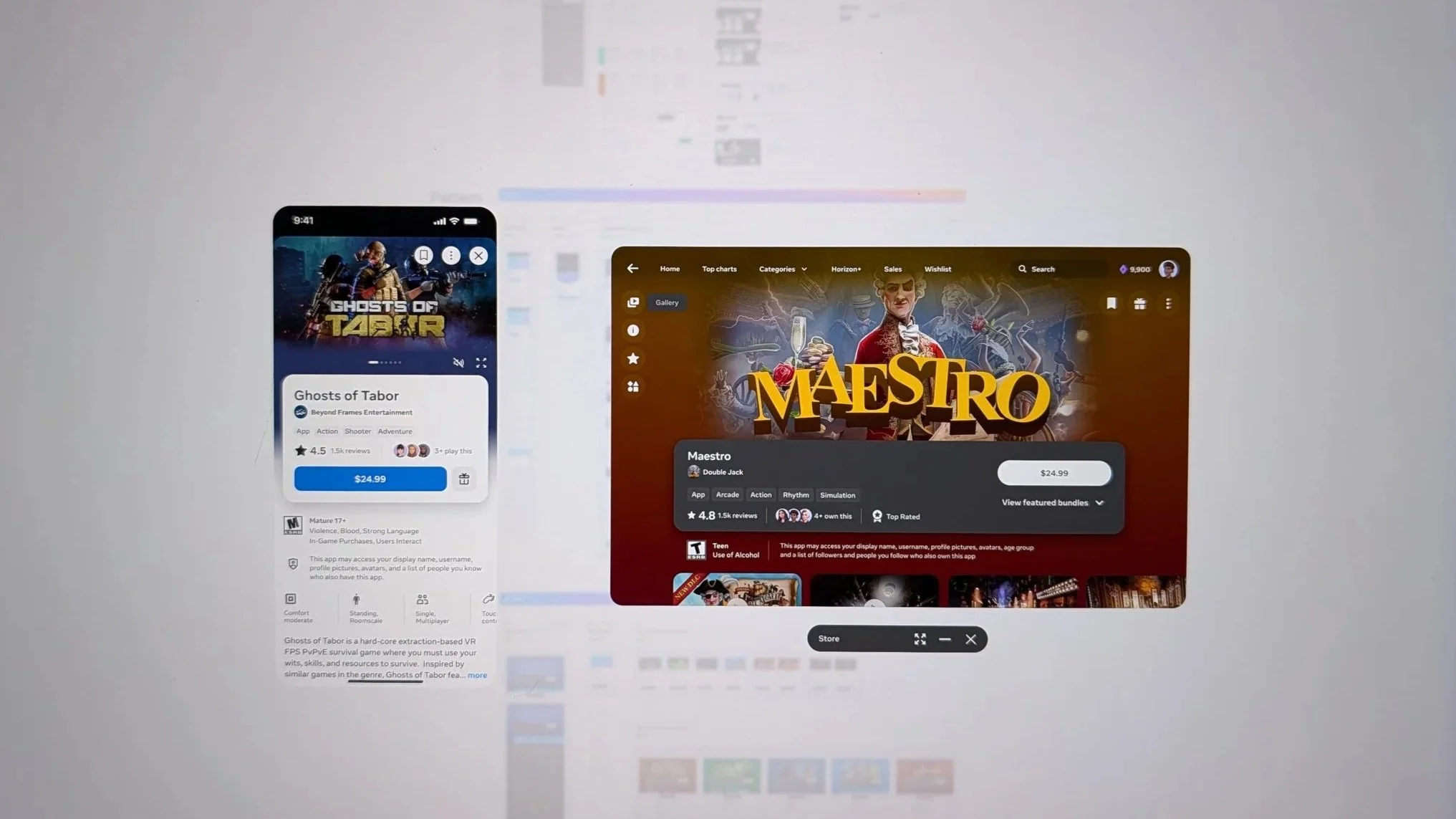
I collaborated with a fellow designer who had established a unified product detail page (PDP) system across diverse content types to formalize a PDP template pattern within our product system.
Through coaching the designer on effective patterning in Figma, I helped produce a template that robustly supports content categories such as games, events, worlds, and media.
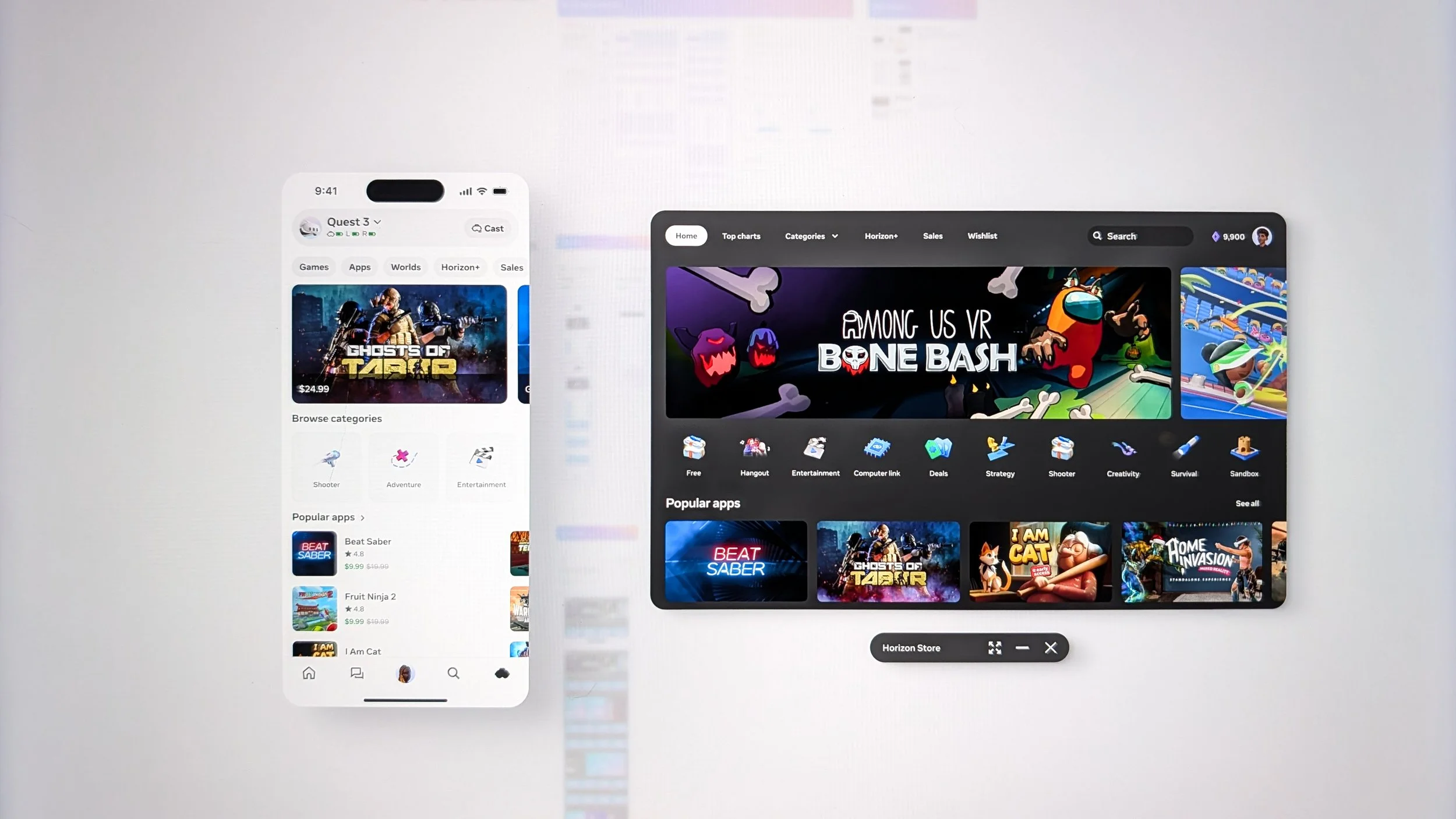
Spanning multiple facets of the Economy experience, the Store template was essential to document. I collaborated closely with the lead designer for Store and Categories to develop refined templates and detailed grid systems. These resources served as a reference for numerous partners across their flows and allowed Creative and Marketing teams to integrate assets seamlessly for campaign visualization.
Account Templates
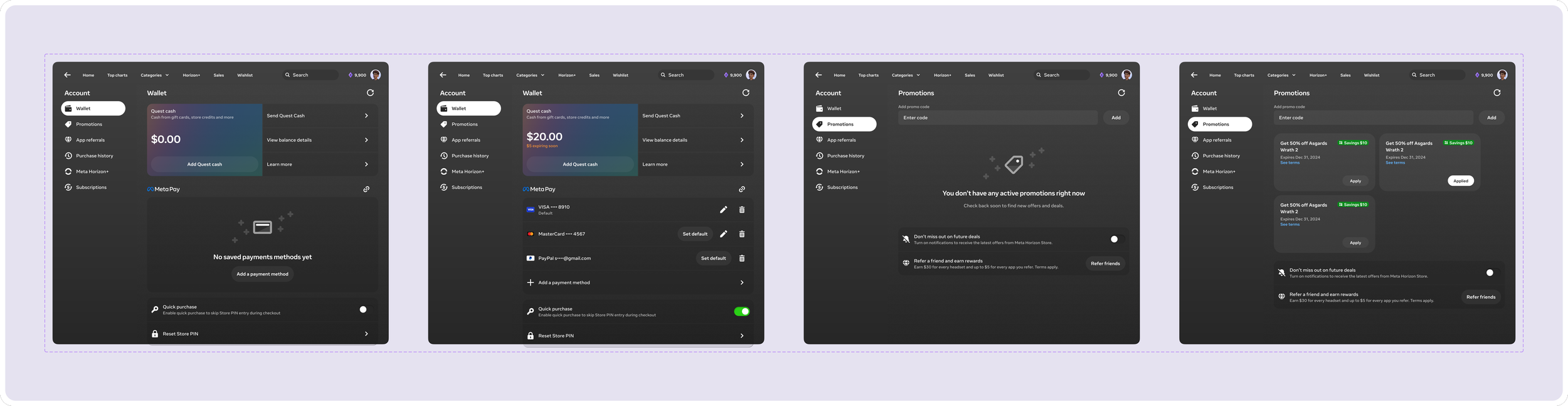
Wallet is our central hub for user to manage their payment methods. I managed this surface over my tenure at Meta as a key DRI for partners to connect on changes to the Wallet. Including our direct integration with MetaPay, Meta’s global wallet or payments hub for all Meta products (Facebook, Instagram, Horizon, etc.)
I also maintained our promo hub to ensure it stayed up to date with our latest design system standards and experiences.
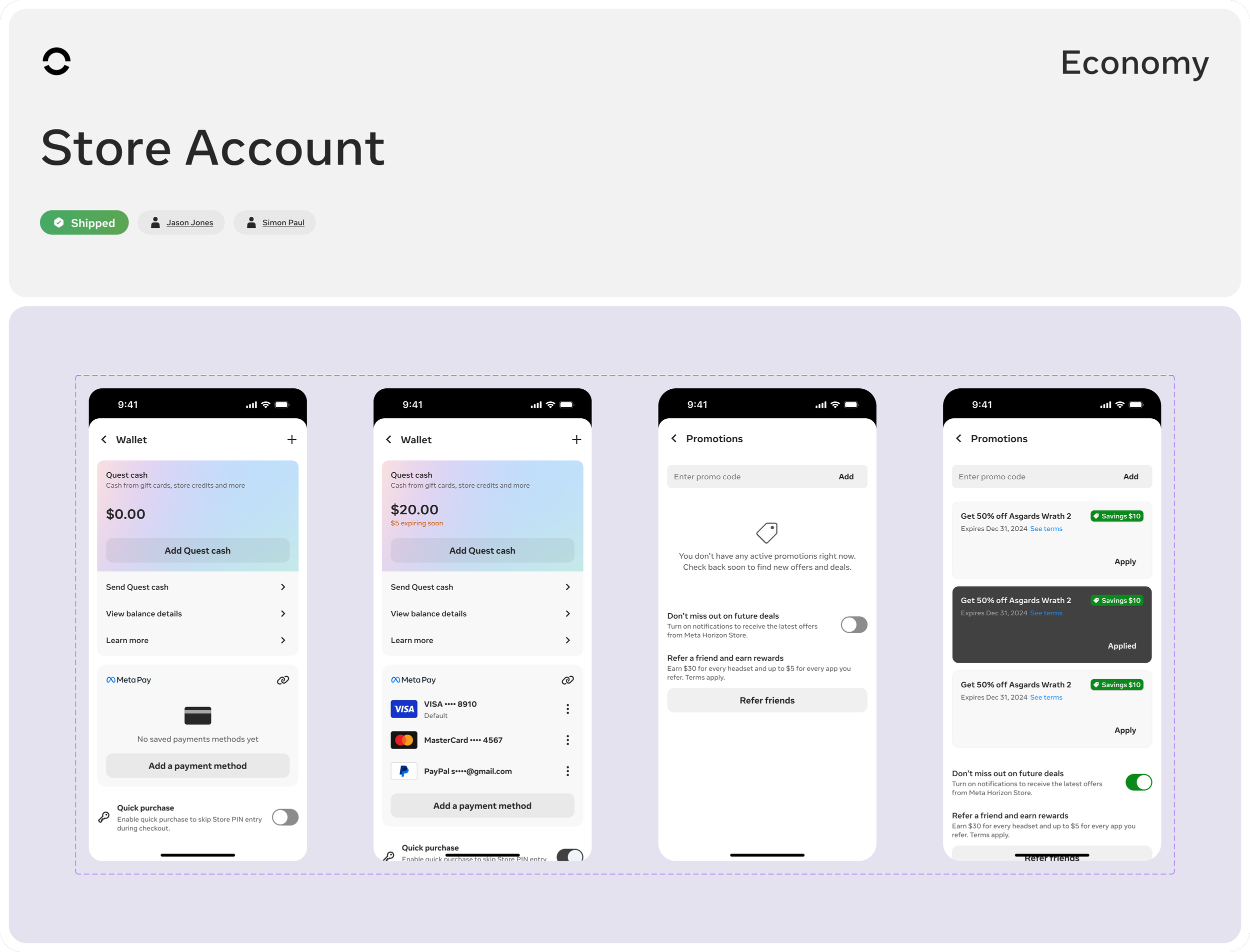
For my tenure at Meta, driving systemization with my peers was a multi-faceted exercise that included influence in daily syncs or crits, coaching specific partners on a workshop, and building the foundations to enable them to directly contribute.
Empowering others to co-build the system created a unique set of challenges where methods, naming conventions, and other conventions needed be consolidated and cleaned up over time. I established a clean flow to go from staging, to migrating, publishing, and updating. This included maintaining a change log, and posting weekly announcements about updates and priorities.
Figma Organization
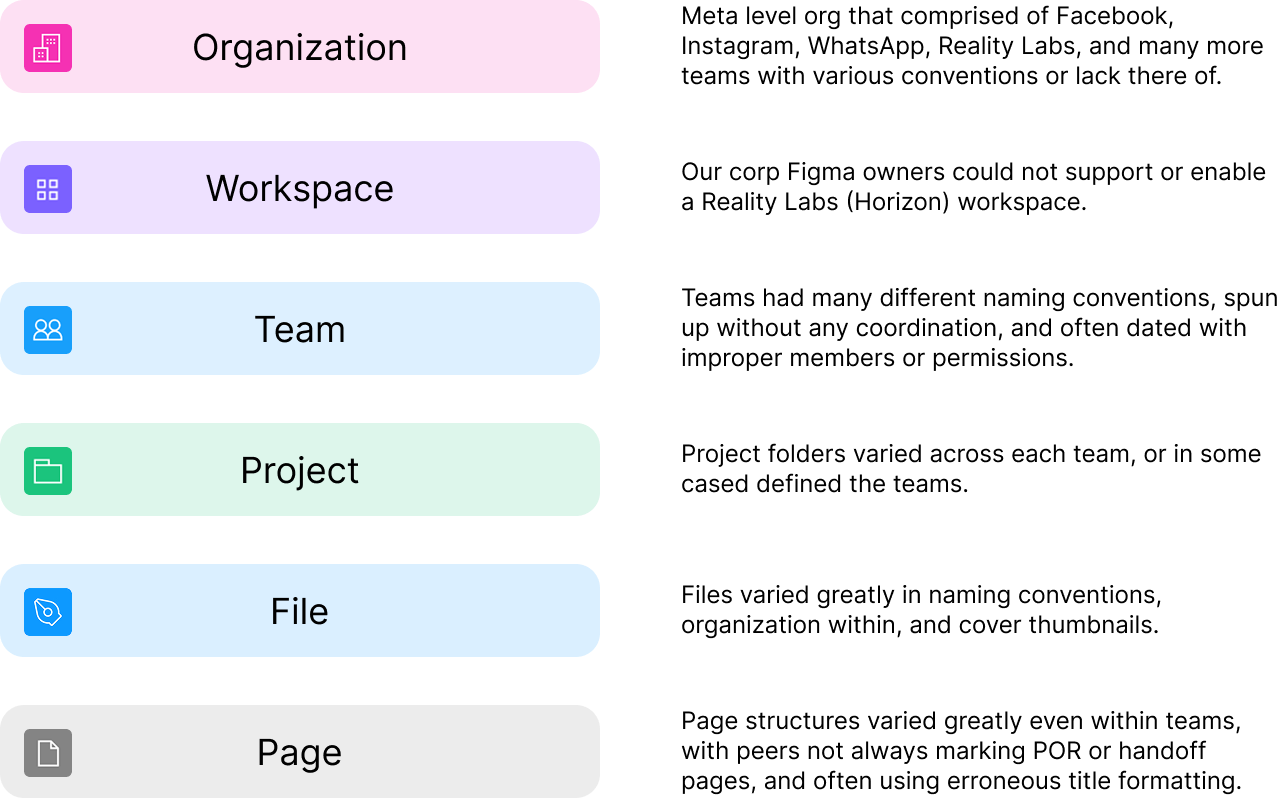
As a member of the Figma Organization Committee at Meta, I was tasked with bringing order to a highly fragmented design ecosystem within Reality Labs. Across more than a dozen teams, discoverability and structural consistency had become significant roadblocks, hindering cross-functional collaboration and slowing down our broader design operations.
Timeframe
2025
Role
Product Design VI
The Challenge
Our design infrastructure was suffering from organizational growing pains, leading to several critical inefficiencies:
Poor Discoverability: Peers, cross-functional partners, and leadership struggled to locate the latest point of record (POR) or understand what specific teams were actively working on.
Inconsistent Architecture: Figma environments were a chaotic mix of official "Teams" and loosely defined "Projects," further complicated by teams erroneously setting up unmanaged spaces outside of organizational protocols.
Lack of Standardization: File naming conventions, structural organization, and Figma cover thumbnails varied wildly across the organization, making navigation tedious.
Fragmented Resources: Foundational templates for presentations and design files were scattered across disparate documentation and heavily siloed.
Access Management Bottlenecks: Permissions were disorganized, creating a messy user-access environment that was difficult to manage and scale.
The Strategic Solution
To resolve these systemic issues, our committee evaluated the existing landscape and defined a unified operational structure. I took a leading role in designing the architecture and creating a centralized access point to govern this new ecosystem.
Architecting the "Design Hub": I spearheaded the creation of a centralized hub—a comprehensive Figma prototype accessible via a memorable internal short URL. This served as the single source of truth for all organizational resources and structural documentation.
Defining Systemic Naming Conventions: I collaborated with fellow designers to establish strict file naming protocols. This included introducing the [MV] shorthand for Metaverse products, allowing peers to instantly identify official Reality Labs product files.
Establishing Structural Hierarchy: I partnered with the committee to evaluate and explicitly define when and how to utilize Figma "Teams" versus "Projects," creating a scalable blueprint for the organization.
Authoring Organizational Guidelines: I contributed heavily to our overarching Figma guidelines, defining protocols for file creation, discoverability best practices, and a clear peer-contribution model for adding content to the Design Hub.
I created template for Team thumbnails for easy propagation across all our teams. This also created a clear visual identify for official teams within our larger Figma org cluttered with random teams.

Example of some teams, not exhaustive or representative of real teams
Key Deliverables
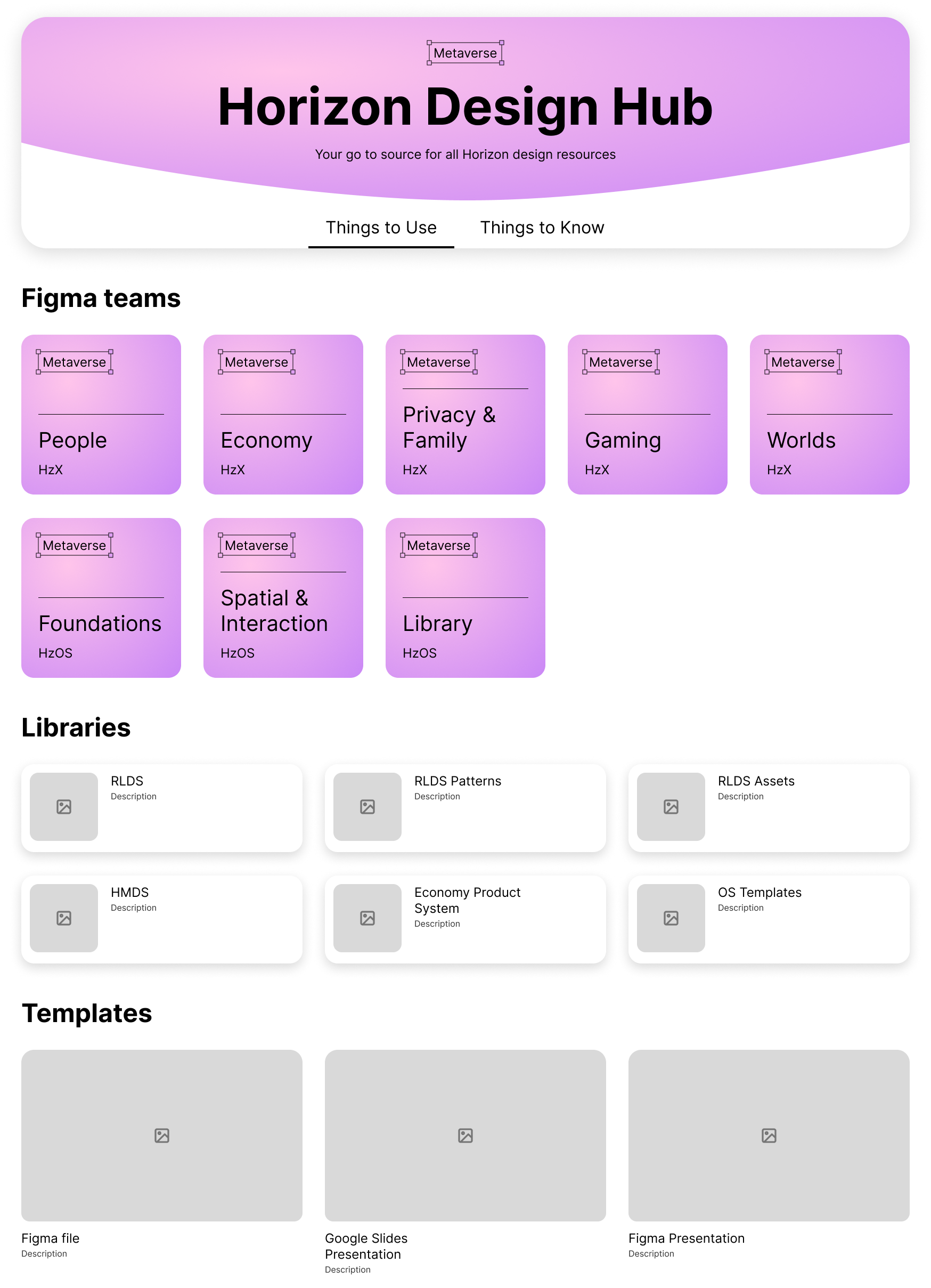
Wireframe concept, not actual product representation
The Design Hub: A centralized portal linking to all product teams, design systems, product libraries, organizational resources, and visual examples of our architecture.
Unified Team Environments: A reorganized Figma ecosystem featuring consistently named teams, paired with unified thumbnail branding and a standard cover template.
Standardized Asset Templates: A comprehensive, easily accessible suite of templates for Figma files and organizational presentations.
Governance & Contribution Process: A streamlined intake form and operational process for submitting new resources or requesting structural changes.
Educational Rollout: An instructional video featuring key partners and myself, walking the organization through the newly aligned guidelines to ensure smooth adoption.
The restructuring fundamentally transformed how Reality Labs operated within Figma. By centralizing our resources and standardizing our architecture, we dramatically reduced operational friction and empowered designers to focus on craft rather than logistics.
Increased Operational Efficiency: Teams experienced a significant drop in ad-hoc requests and pings from stakeholders searching for the latest designs.
Cross-Team Alignment: The implementation of standardized templates led to an immediate increase in consistency across project presentations and file structures organization-wide.
Enhanced System Adoption: With resources clearly mapped and highly visible, teams demonstrated a much higher utilization of available patterns from partner design organizations.
Hardware Bundles
As part of the launch for the Meta Quest 3S, we partnered with Batman: Arkham Shadow creators to bundle the game with new headsets. In previous bundles, the org experience disappointing redemption rates for bundled content. In partnership with product, marketing, and brand teams, I lead the creation of a Hardware bundle framework to establish a clear set of re-usable patterns to drive redemption.
We had some small pilots with other bundles, but our primary case was the Quest 3S launch bundle.
Timeframe
2024
Role
Product Design VI
The Framework
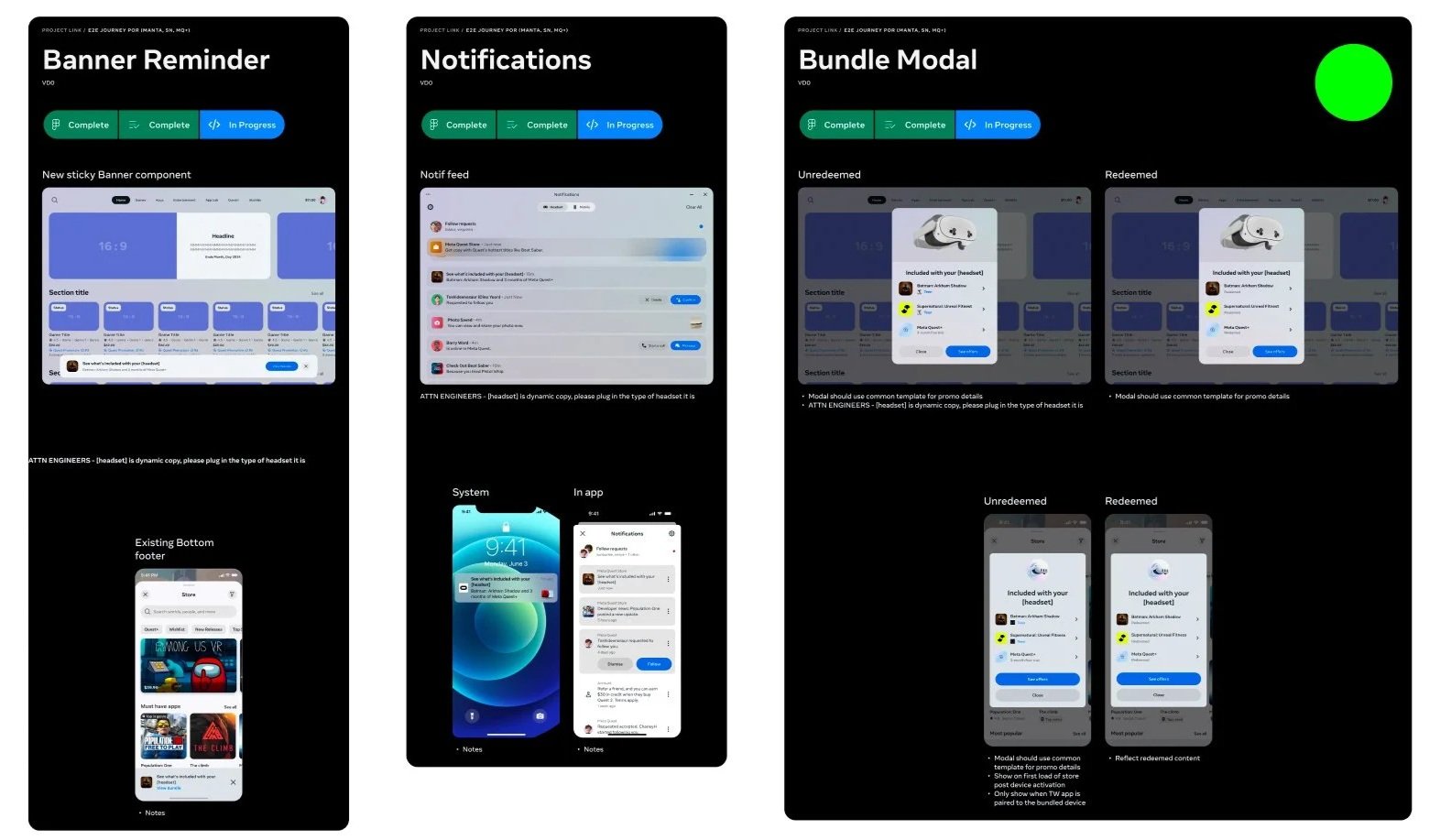
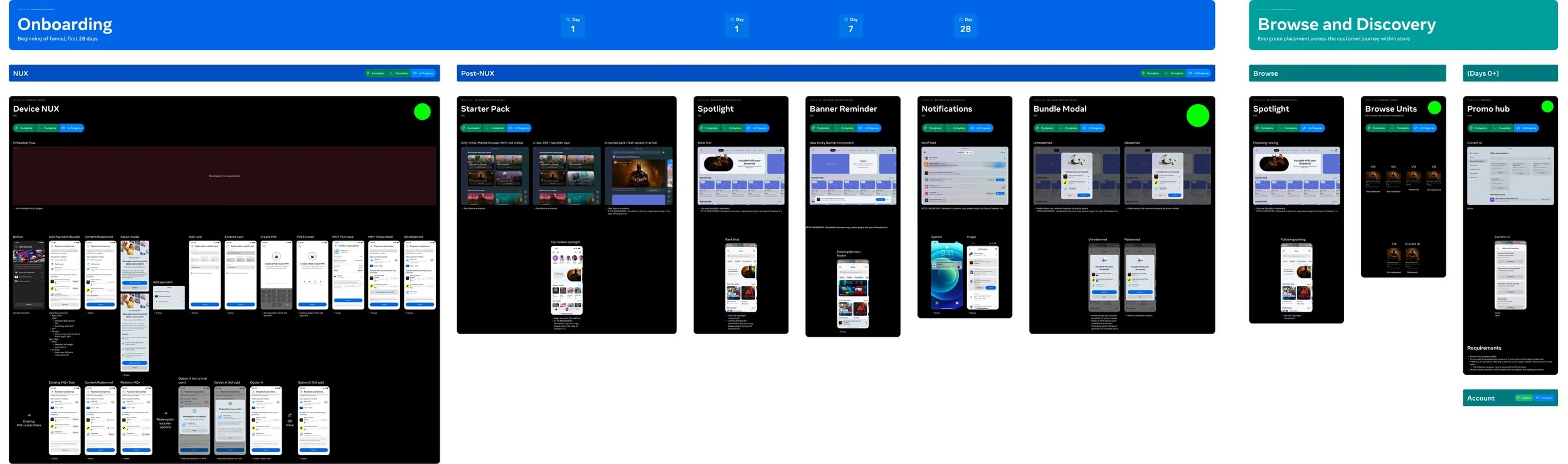
I established a matrix for the end to end user experience across all our digital touchpoints (Web, Mobile, VR). Each surface was used at different key moments in the journey, and had unique patterns to support the user needs at that point in the journey.
The framework included, spotlights, banners, emails, redemption modules, onboarding screens, and notifications.
I had to balance a variety of scenarios, including different time periods for redemption windows, IP brand requirements, and legal guidelines around disclosures, metadata, and verbiage across the experience.
I partnered with a Content Designer to fine tune the language for each stage of the experience.

The Impact
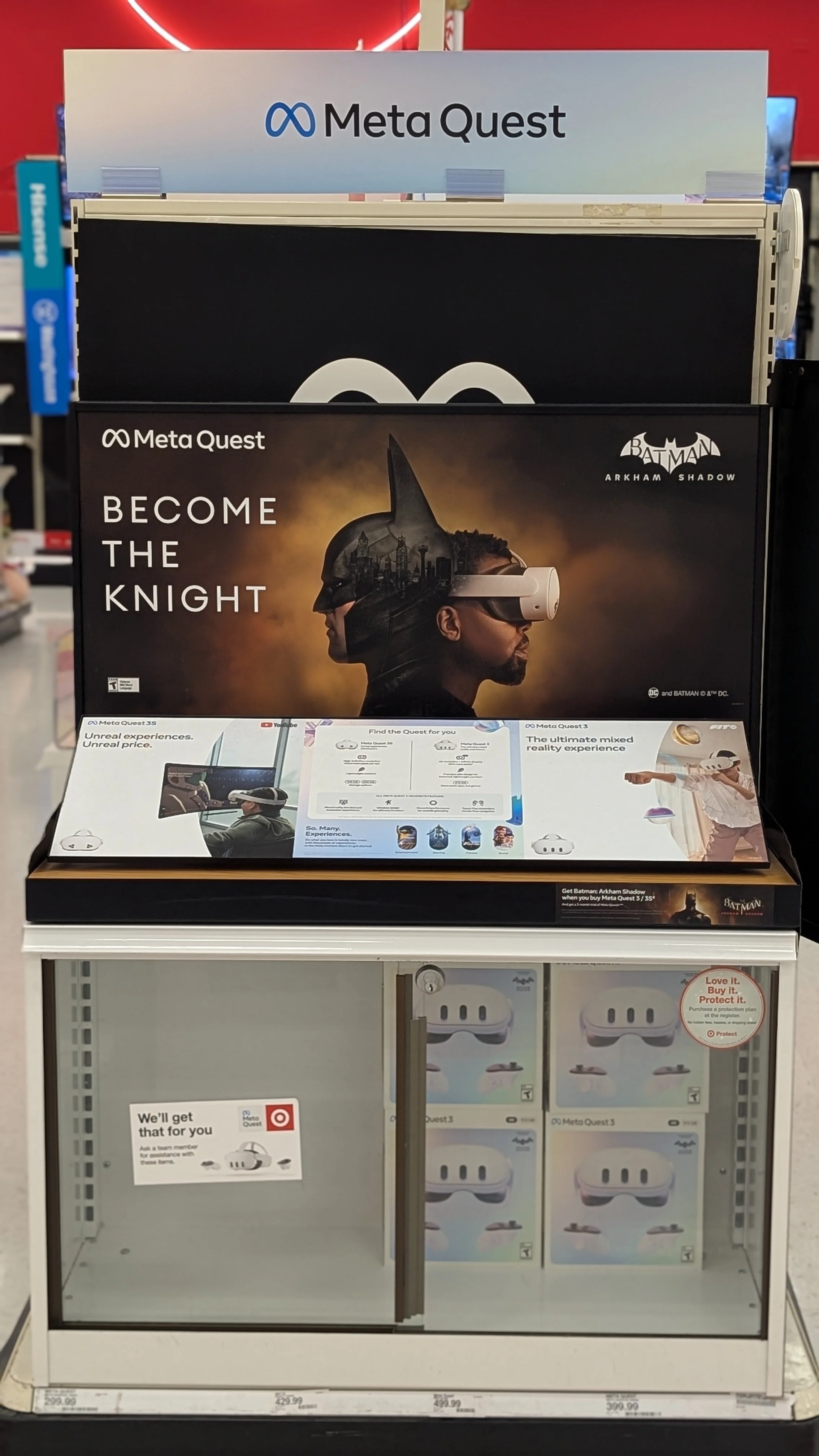
The main bundle campaign was focused on the launch of Quest 3S with Batman: Arkham Shadow in VR.
The experience frame work lead to increased redemption rate compared to previous bundles, and contributed to hitting our sales targets.
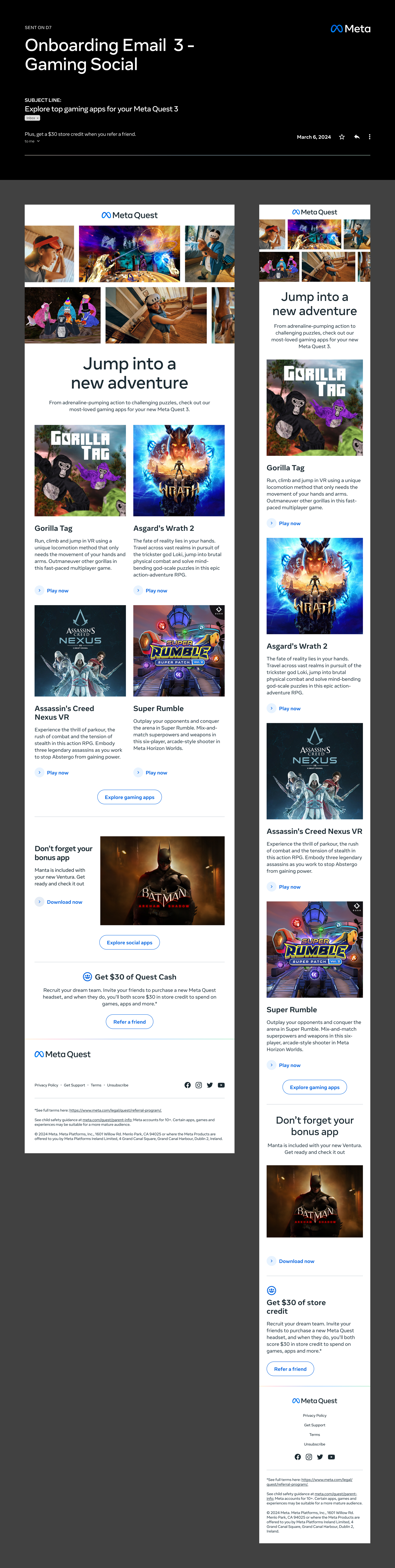
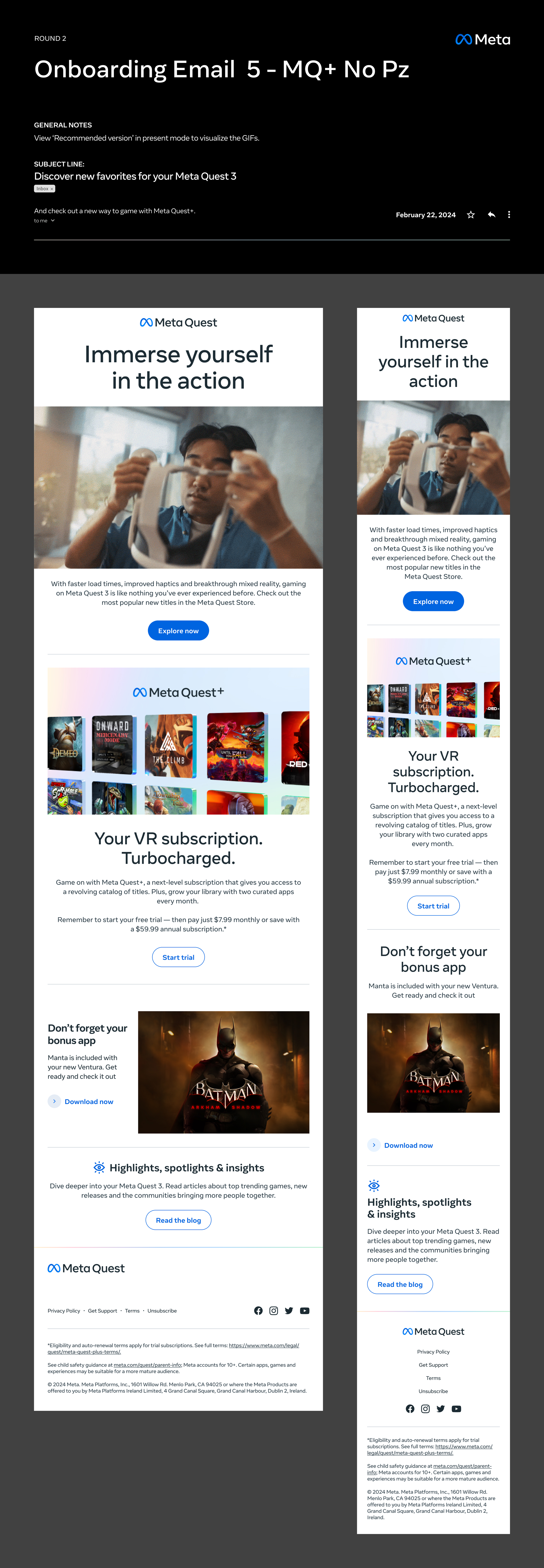
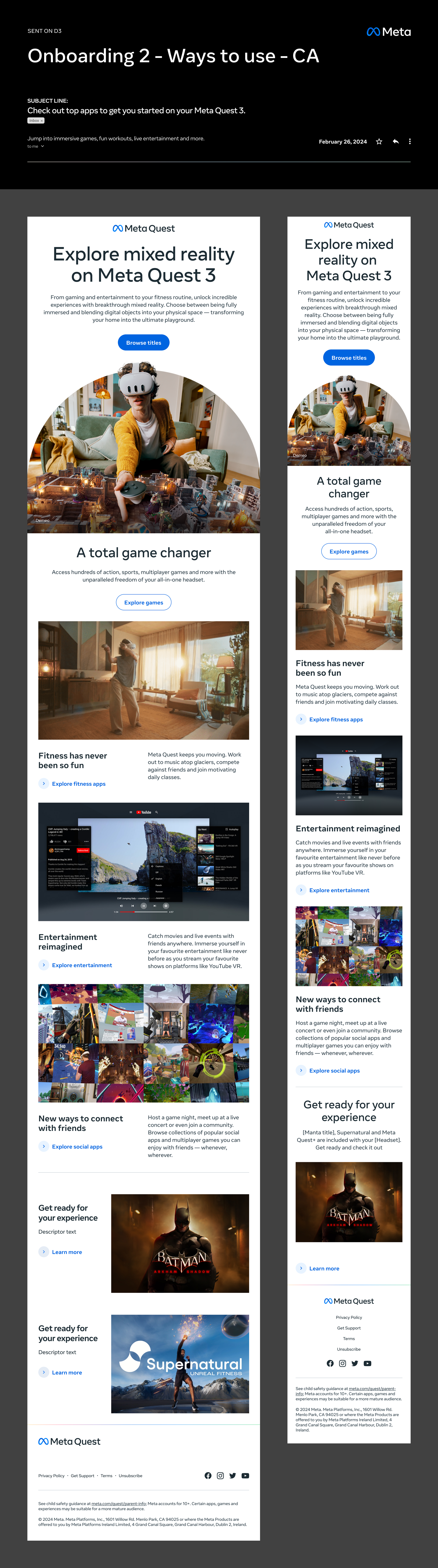
Midway through the project our Product Manager departed, requiring the team to proceed without a PM for a significant period. I took on many of those responsibilities, driving design alignment across stakeholders and ensuring progress stayed on track. The project was especially rewarding: we delivered a time-sensitive experience that required extensive coordination with brand and third-party IP holders. I aligned efforts with web retail, email, and marketing teams, and worked closely with hardware merchandising on packaging design, distribution, and related logistics.
Meta Credits
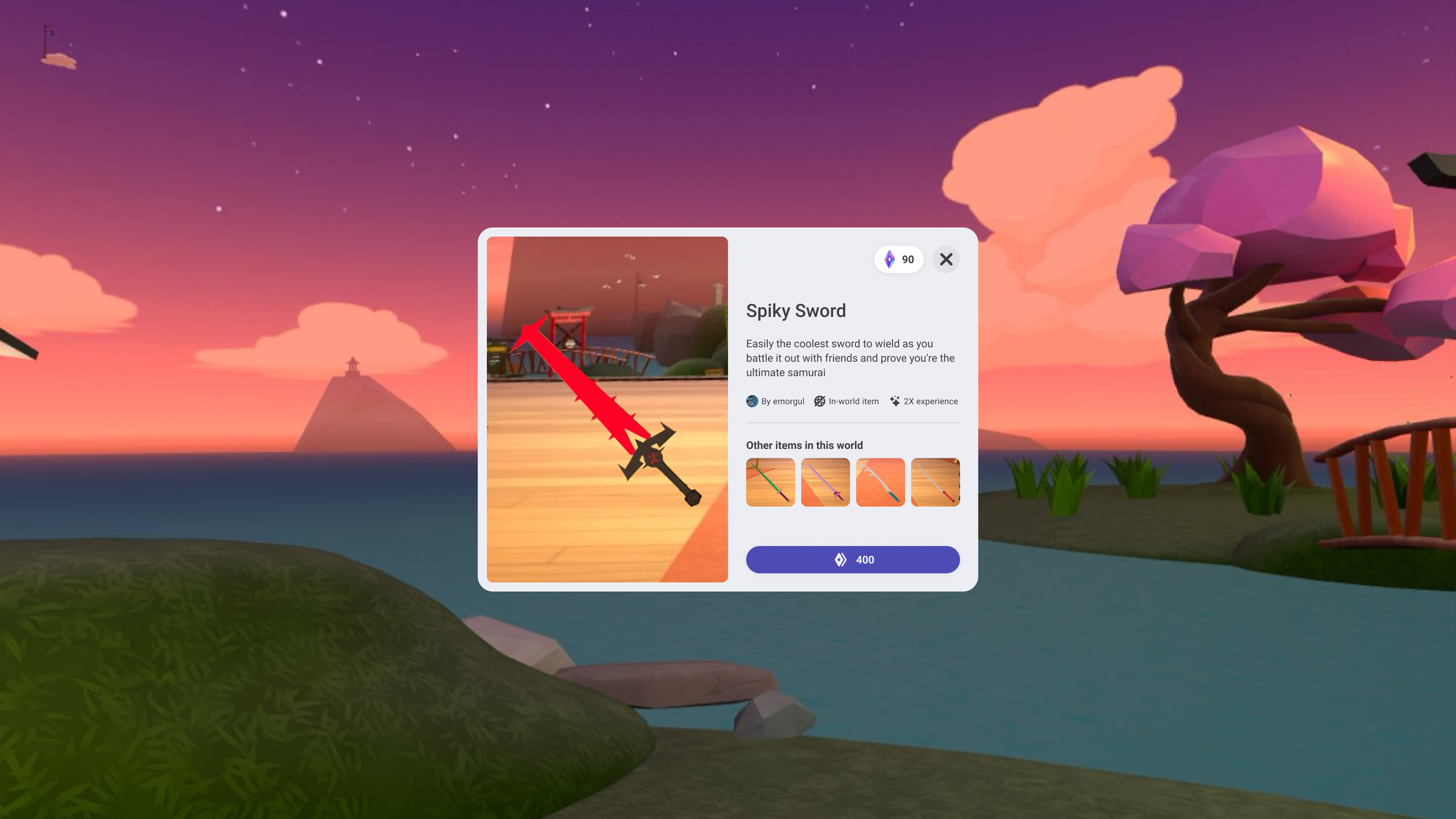
In partnership with another designer, I helped launch Meta Credits in fall of 2024. Our digital token system that supported quick an easy acquisition of digital goods without requiring user to use their payment for each transaction.
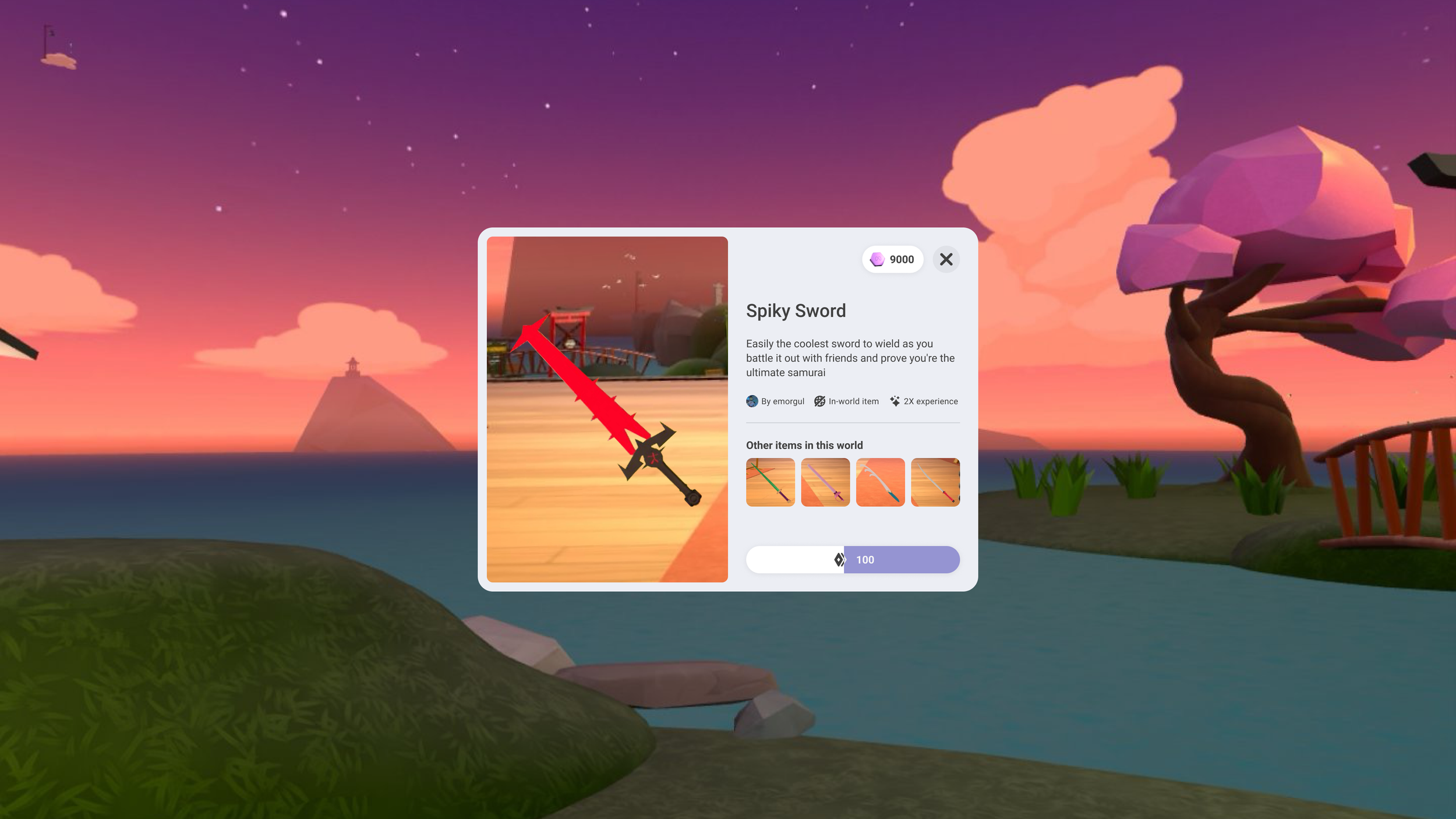
The launch was greatly successful, enabling users to acquiring content in context of their gameplay in Worlds quickly.
Timeframe
2024-2026
Role
Product Design VI
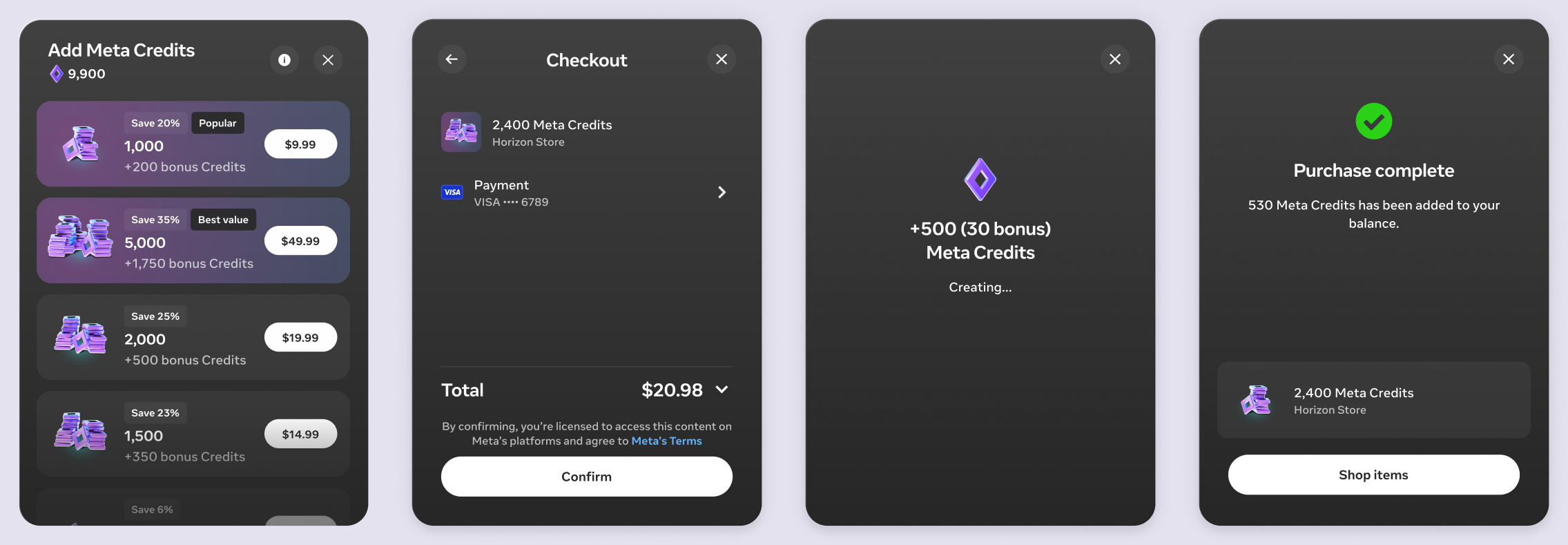
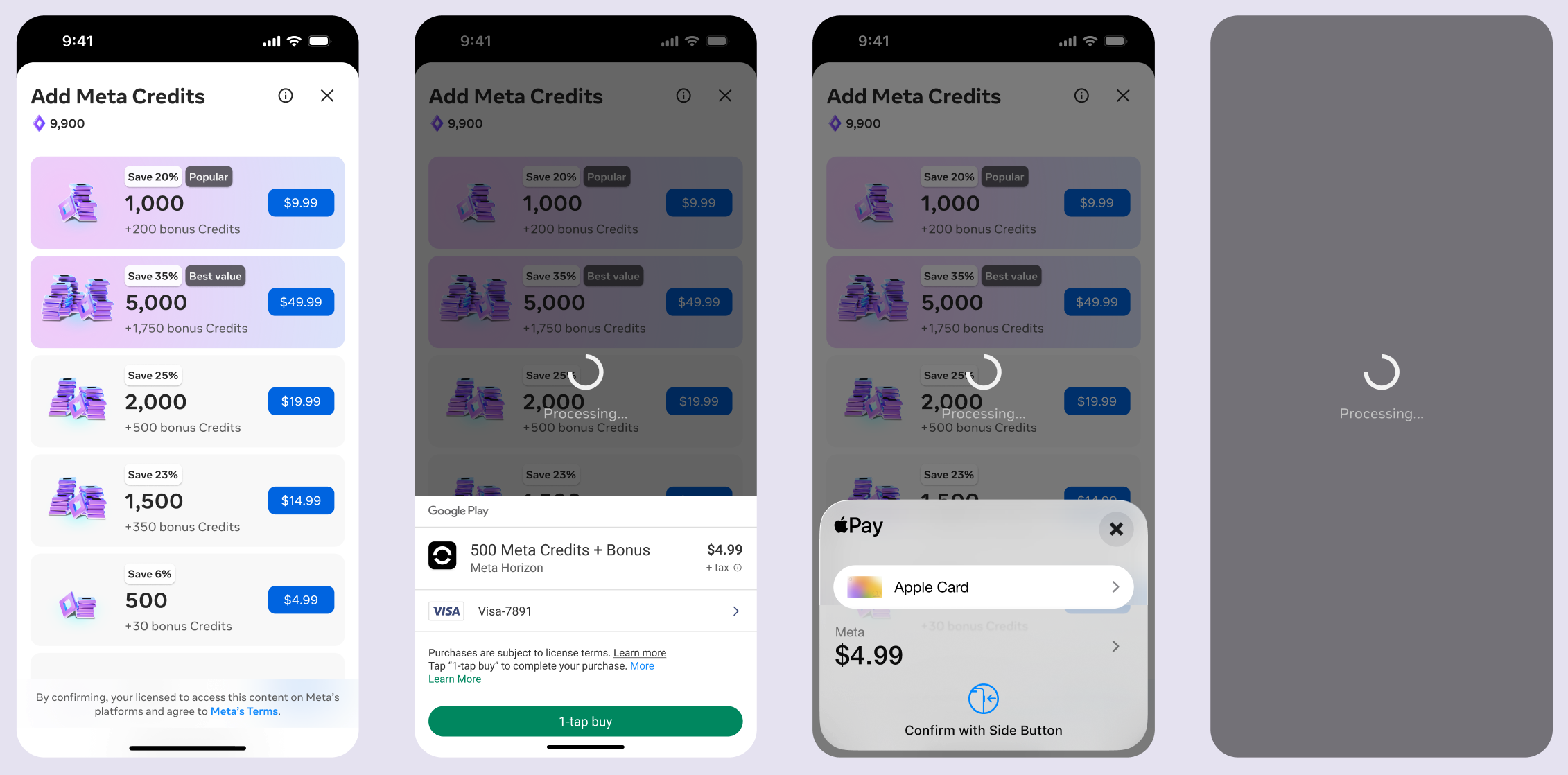
Single click acquisition powered through Meta Credits enabled our customers to get the content want in 2-3s. Alling them to rejoin gameplay quickly and continue their gaming journey.
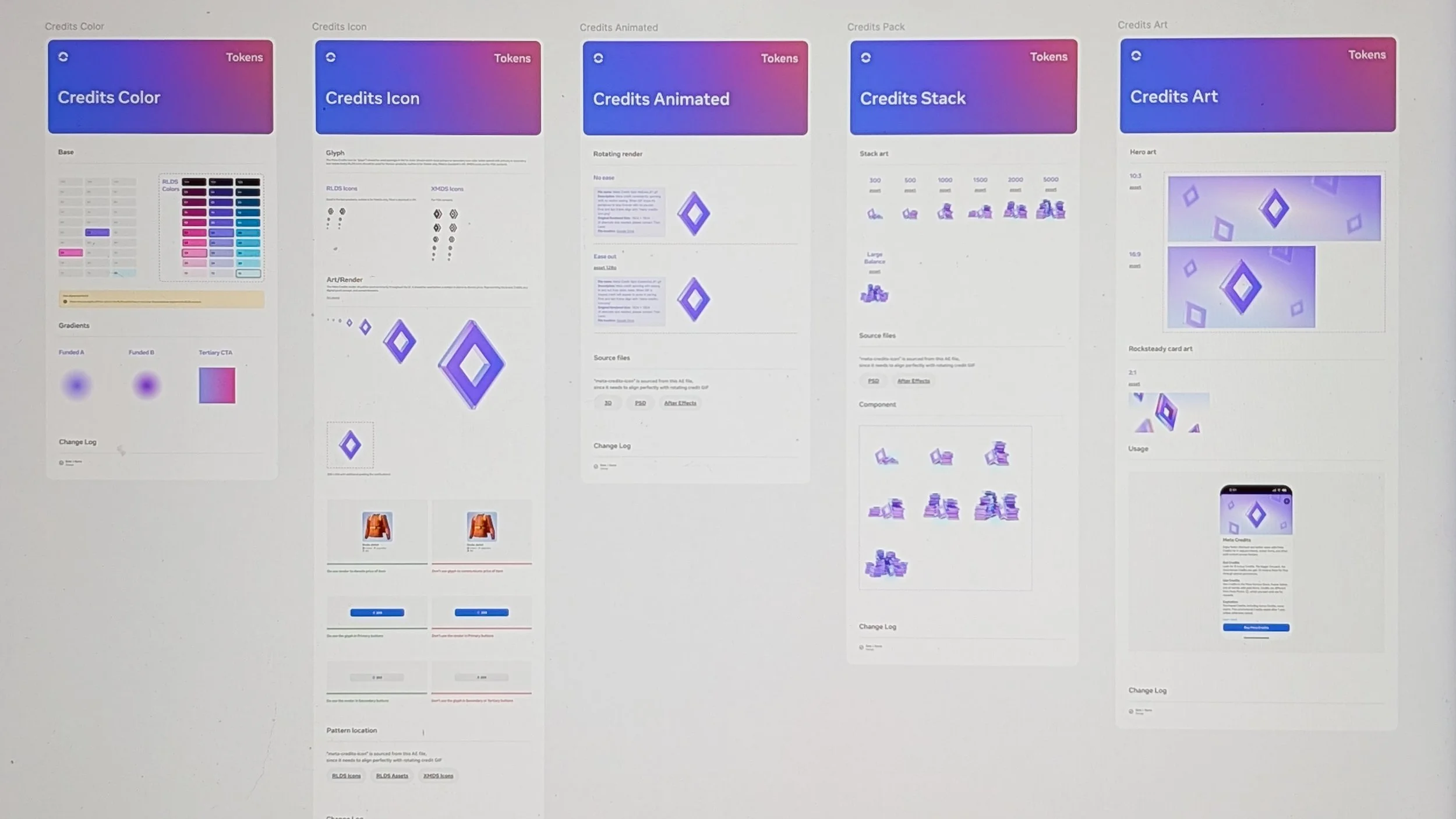
As part of the product system, I consolidated all our Meta Credits assets and standards as well as our core views into the Economy library. This included colors, icons, collection art, components, and views.
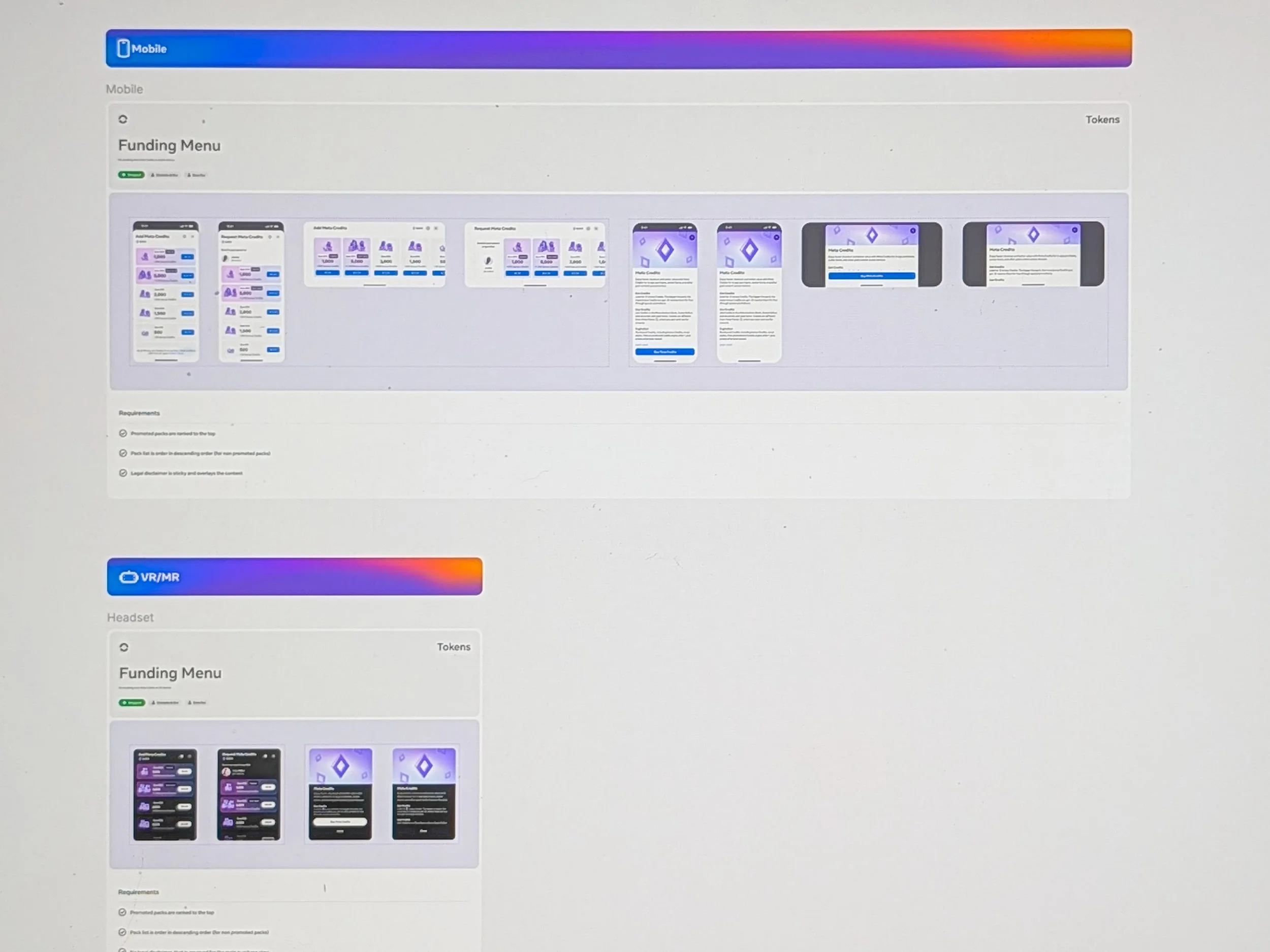
Buy for Me
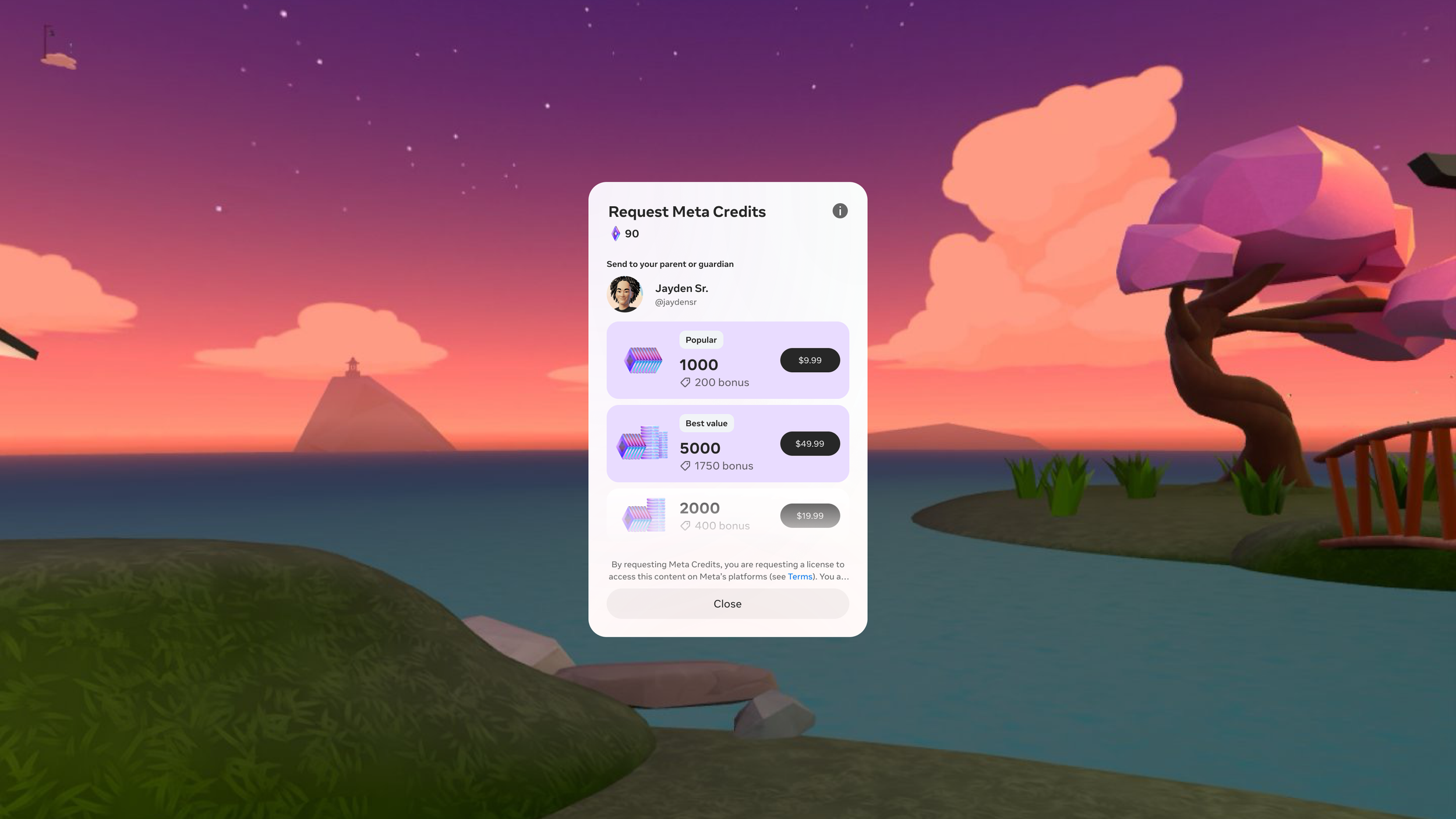
In parallel of supporting the launch work, I lead the Buy for Me flow as a fast follow release. This effort focused on enabling youth users to request Meta Credits from their parents, and parents managing the Meta Credit distribution for their children’s accounts.
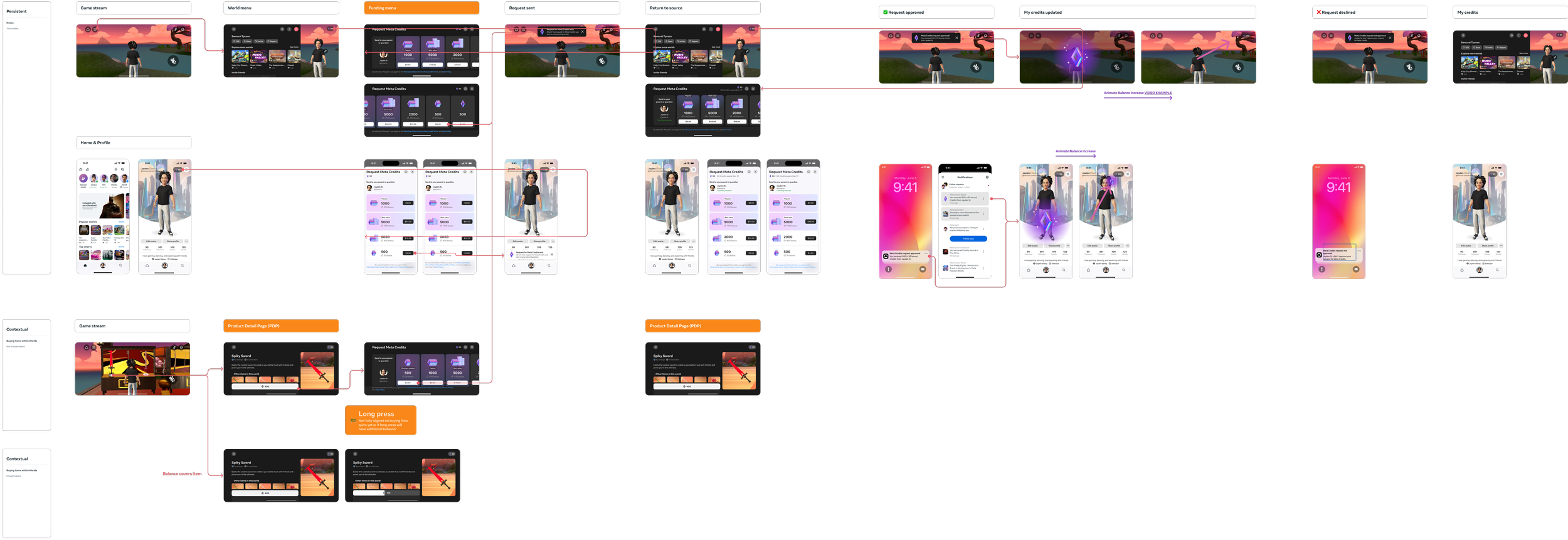
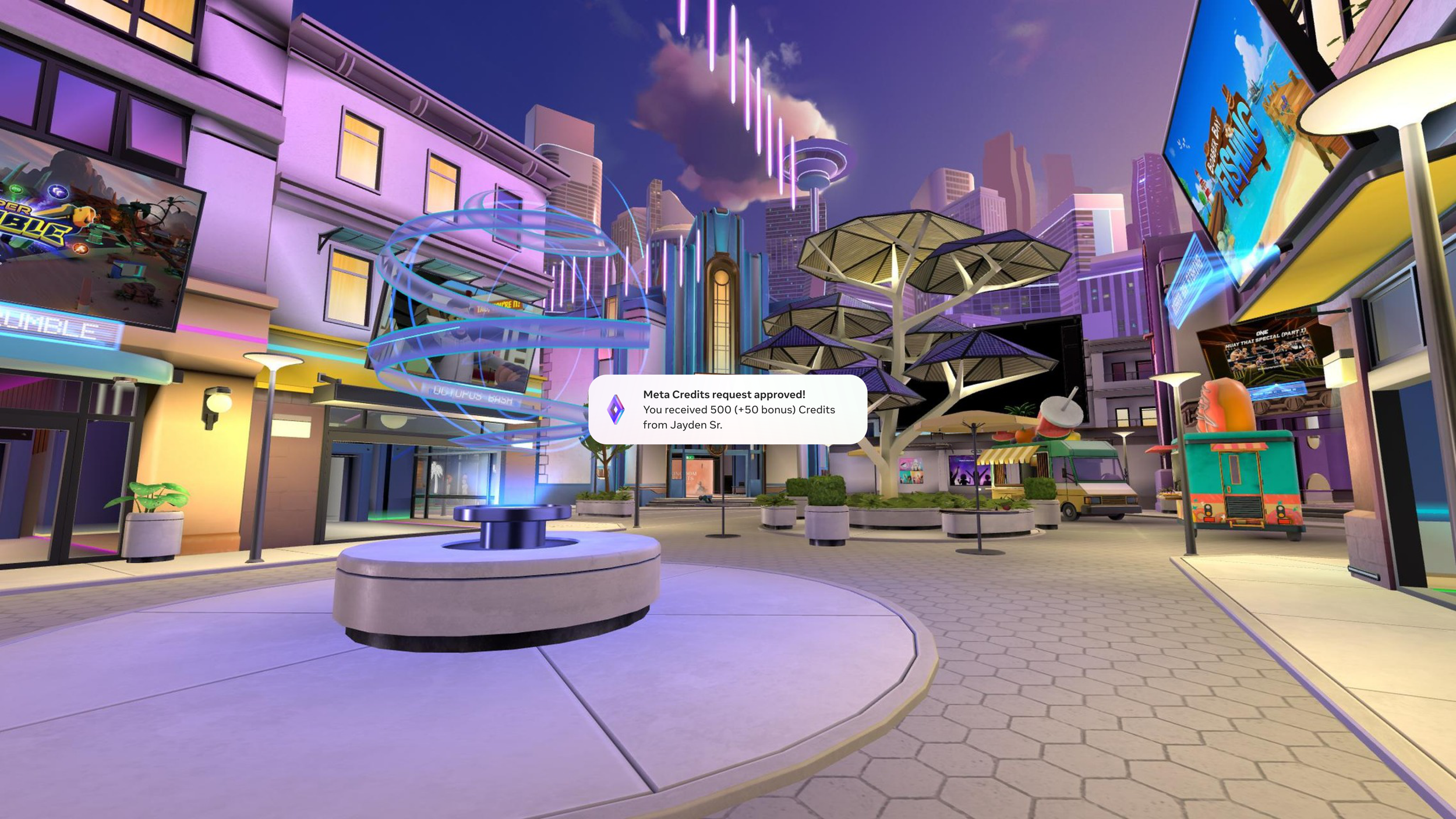
This experience created a clear, repeatable flow enabling youth users to request funds via the standard funding menu by designating a parent as the payer. Parents then receive a notification and a guided path within their Accounts Center to fund Meta Credits.
I collaborated closely with designers and product managers on the Youth and Parent team to ensure the solution adhered to policy requirements and completed legal review to satisfy compliance standards.
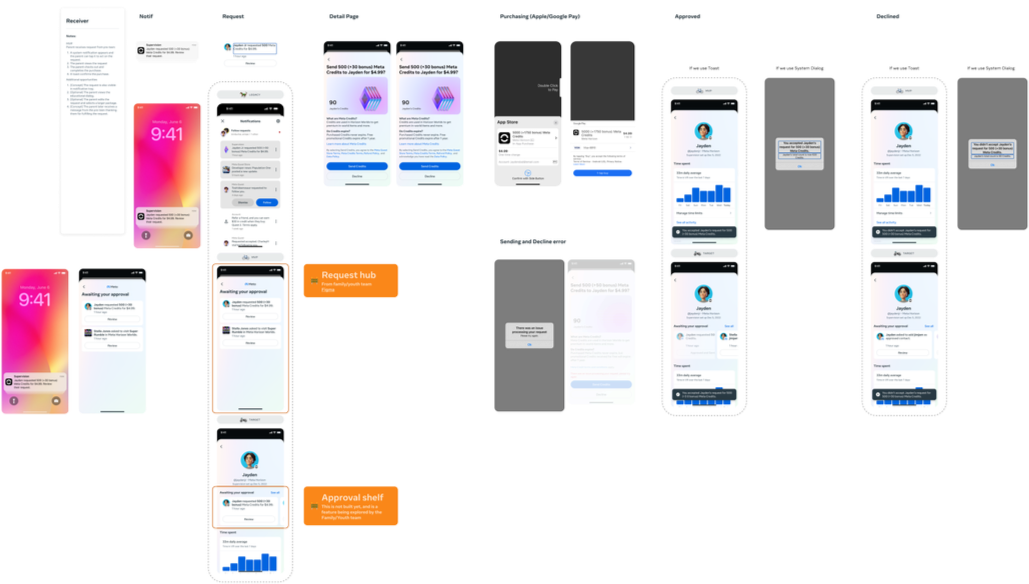
User aims to buy, requests more funds
User gets notif when parent approves
For two years I led product improvements for Meta Credits, driving measurable growth in usage and optimizing the acquisition funnel to a 2–3 second purchase flow, which drove millions of dollars in transactions. As the designated DRI, I served as the primary point of contact for teammates leveraging Meta Credits, and built a close, collaborative partnership with the product manager.
I worked continuously with the Meta Financial Team to align backend financial operations and compliance requirements, while streamlining the end-to-end user journey across VR and mobile digital‑goods experiences. The role combined strategic ownership, cross‑functional coordination, and hands‑on optimization to deliver a compliant, high‑velocity payment experience that scaled revenue and improved conversion.
Meta Horizon+
Early in my tenure at Meta, I joined the team that operated Meta Quest+, a curated subscription service delivering two premium gaming titles per month. I led or co-designed the strategic initiatives that transformed the offering from a limited monthly drop into a comprehensive catalog, driving adoption to over one million subscribers. I also led the rebrand and product realignment to Meta Horizon+ to align the service with broader corporate branding and platform strategy.
Timeframe
2024 - 2025
Role
Product Design VI
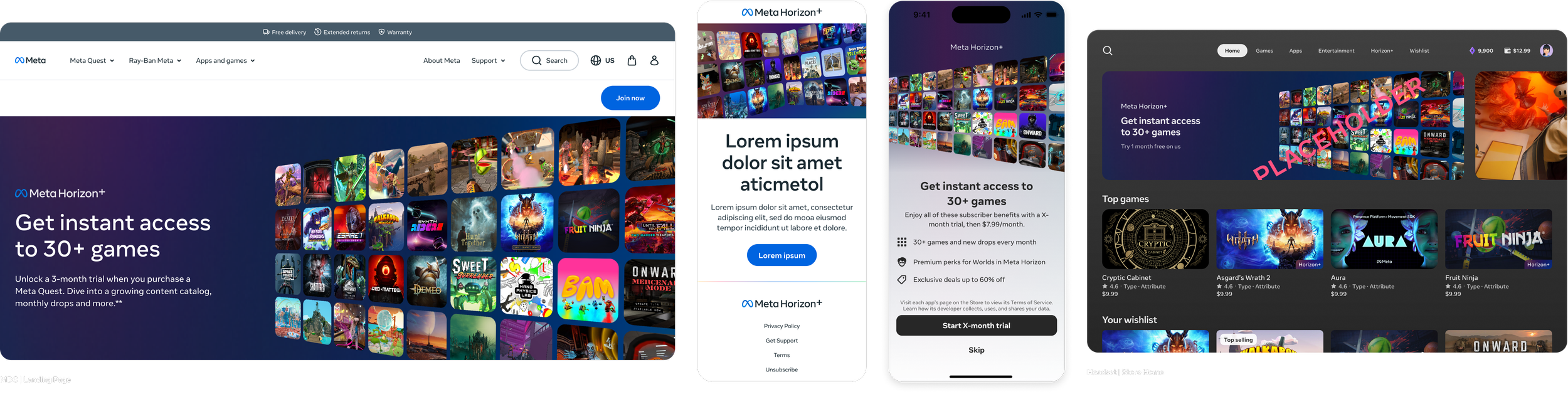
Marketing & Onboarding
I continuously partnered with marketing partners to improve Horizon+’s visibility and value proposition.
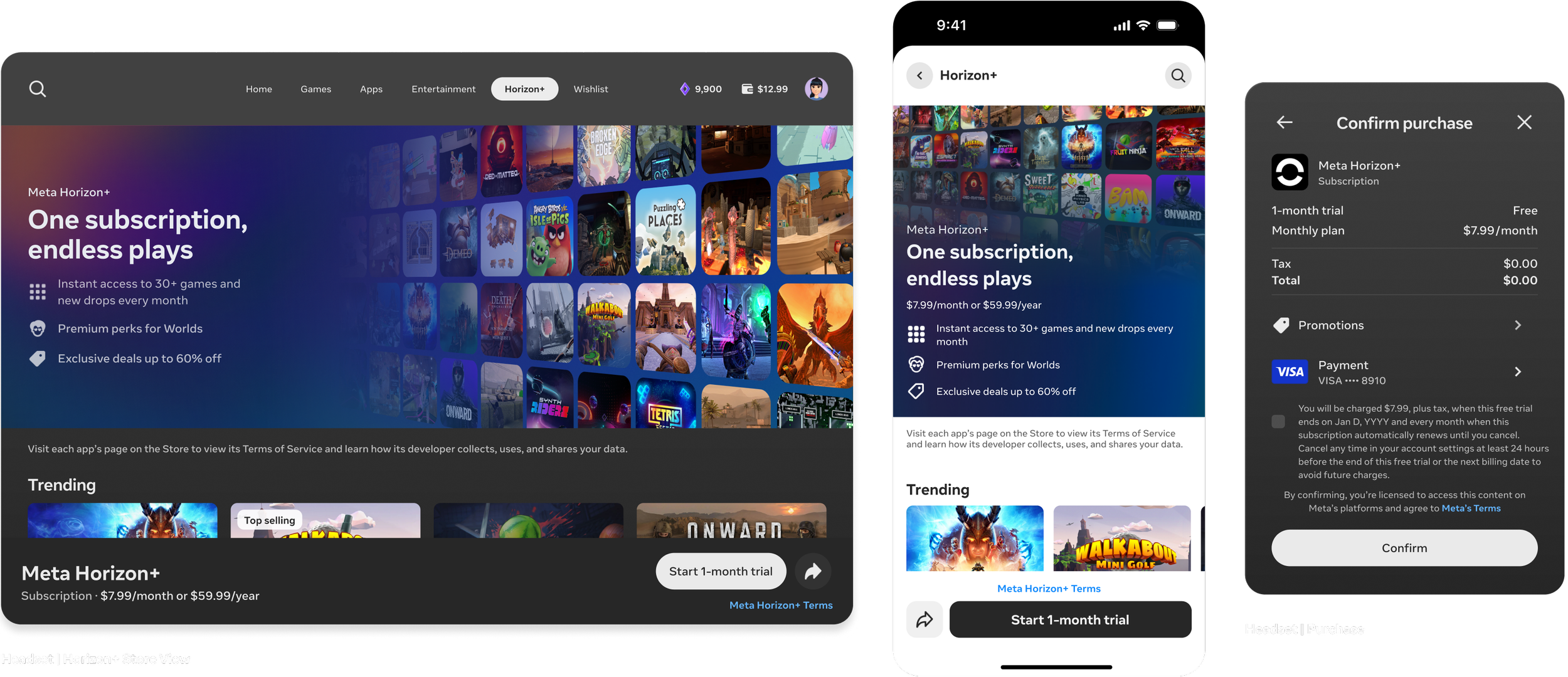
Informing & Subscribing
In partnership with a co-designer, I evolved the product detail page and acquisition funnel to optimize our subscription track.
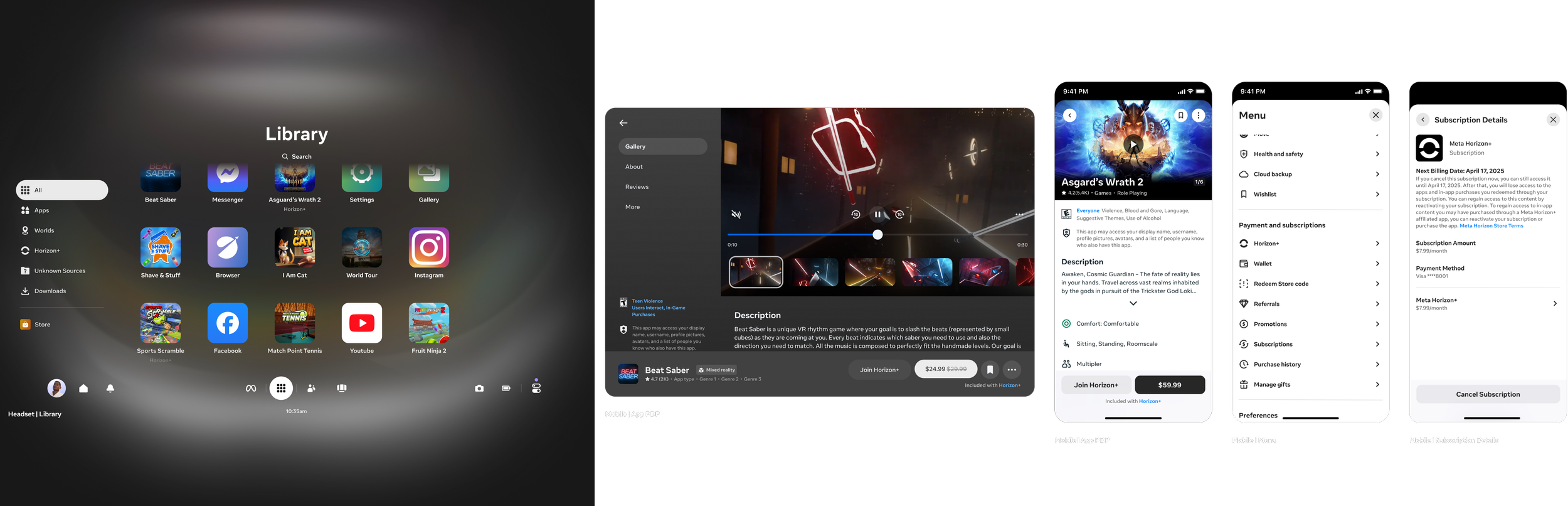
Accessing & Managing
Working with our library designers and product leads, I helped get Horizon+ access directly in the users library, and maintained our management surfaces.
Rebrand Meta Quest+ to Meta Horizon+
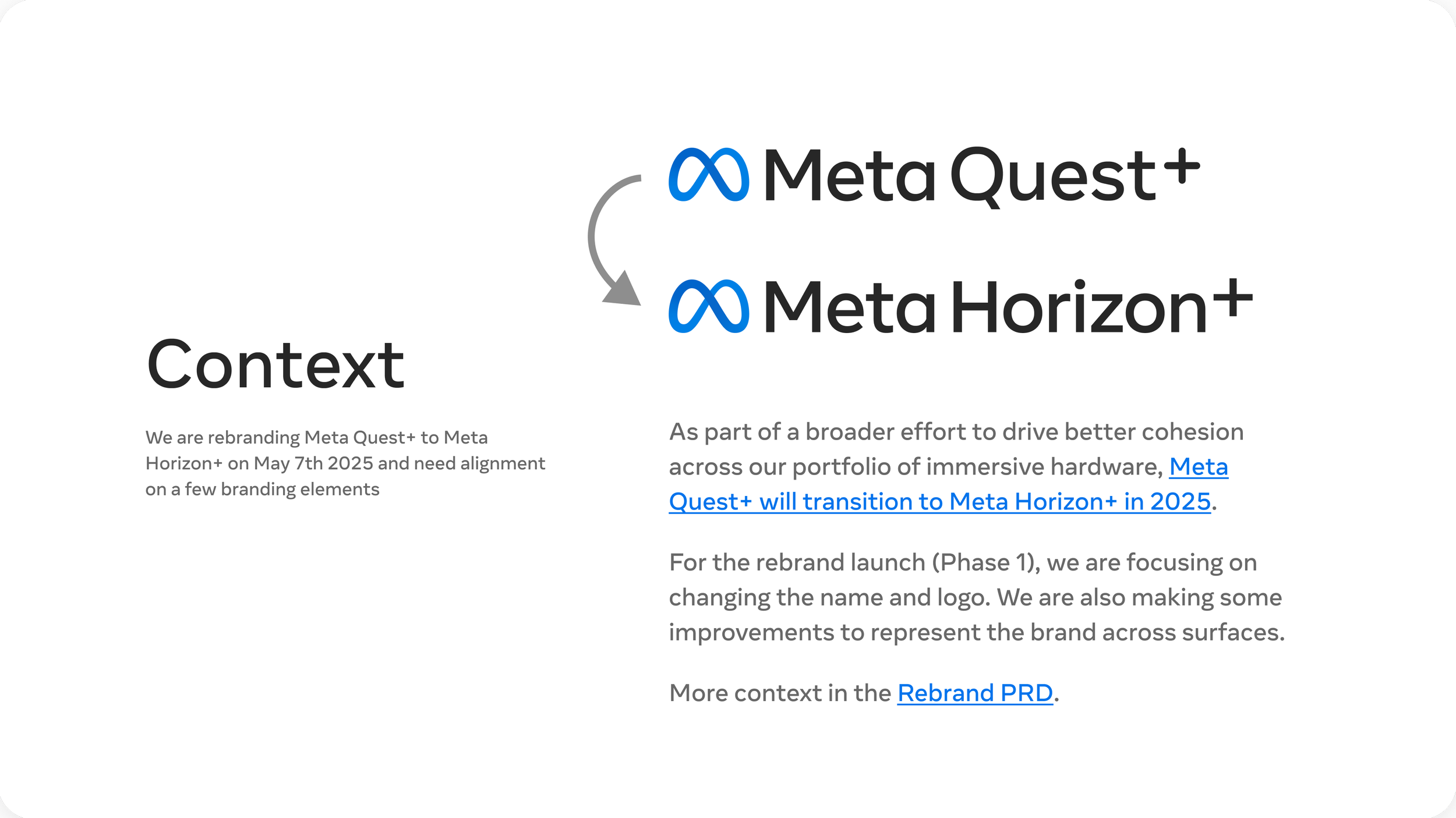
As part of a broader strategic repositioning that designates Horizon for software and experiences and Quest for hardware, I led the design initiative to transition Meta Quest+ into Meta Horizon+. I directed cross-functional teams to synchronize efforts and deliver the rebrand on schedule, and I orchestrated multiple brand and executive reviews to secure approval of the new brand system.
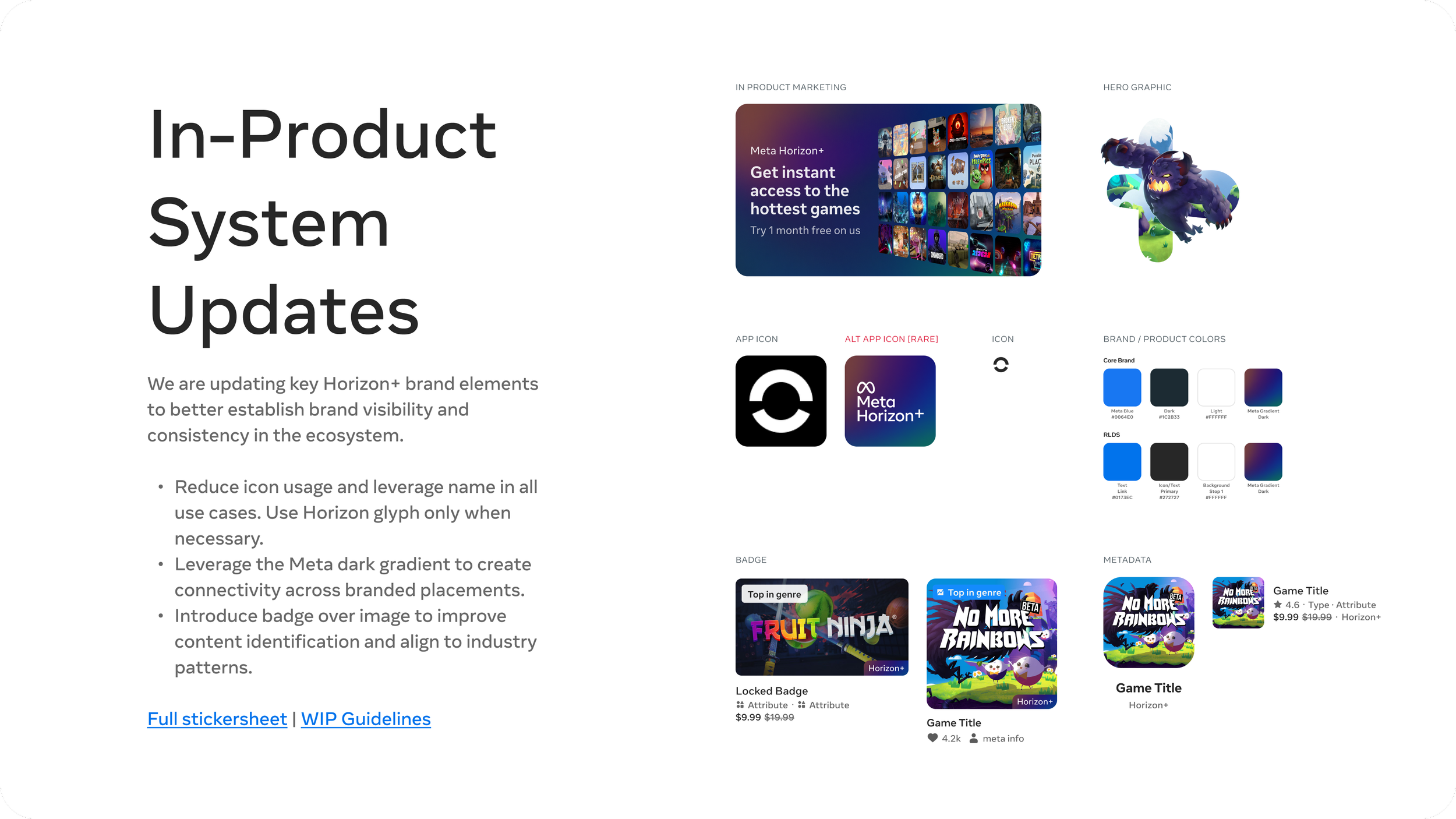
The rebrand encompassed updates to our marketing standards, hero graphics, logo, app icon, color palette, and other visual assets. I coordinated the approval of detailed brand specifications in alignment with the Meta Brand team. As part of the launch, I also implemented improved content badging for the program catalog, which removed an unnecessary fourth metadata line and streamlined presentation.
Scope of Impact
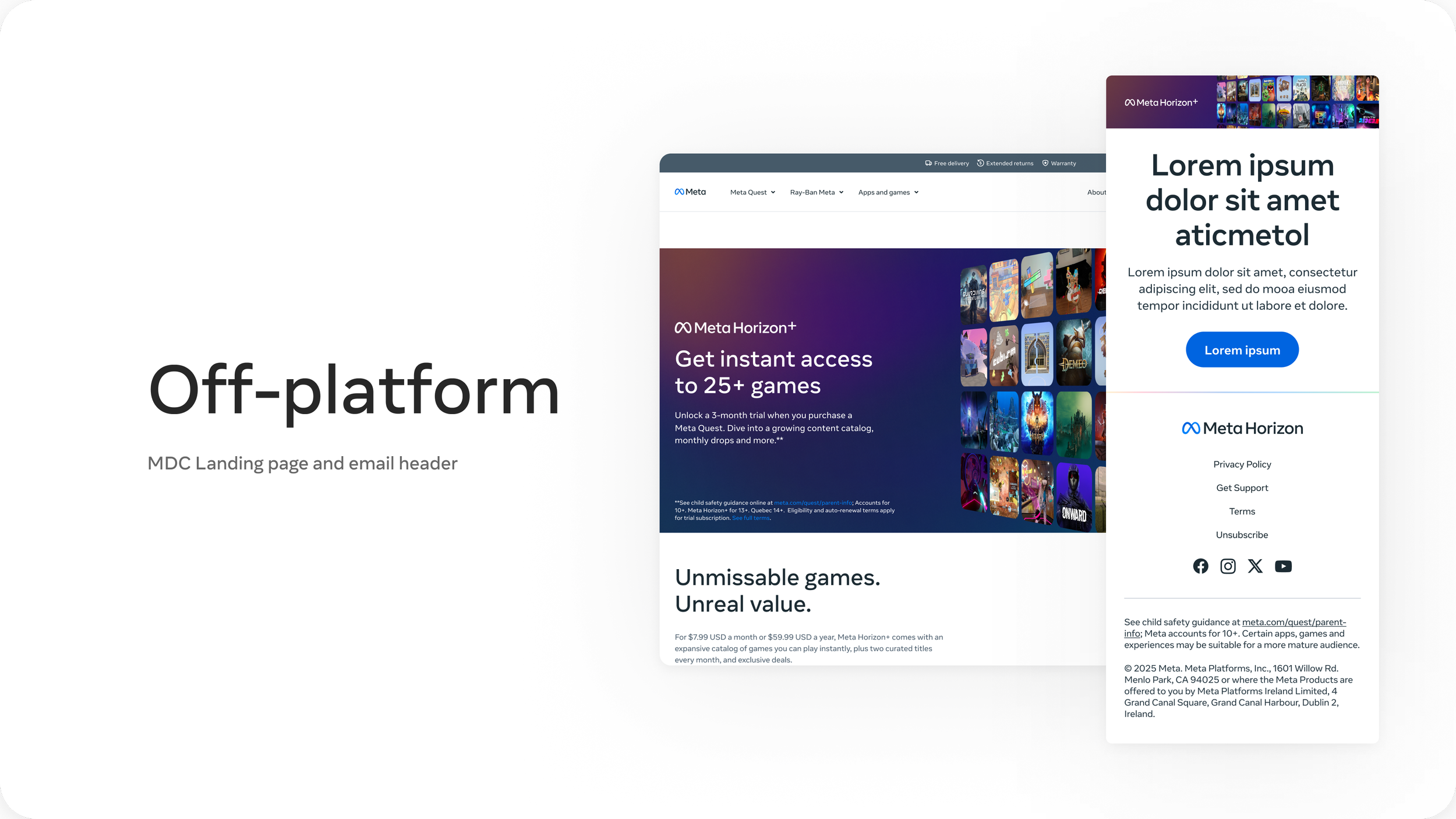
I led the launch of updates to our Meta.com website and email campaign templates, coordinating cross-functional teams including product marketing managers, engineers, legal, and product managers. I also partnered with peers to align in‑platform experiences across VR and mobile, ensuring a consistent brand update throughout onboarding flows, the feed, the store, and the library.
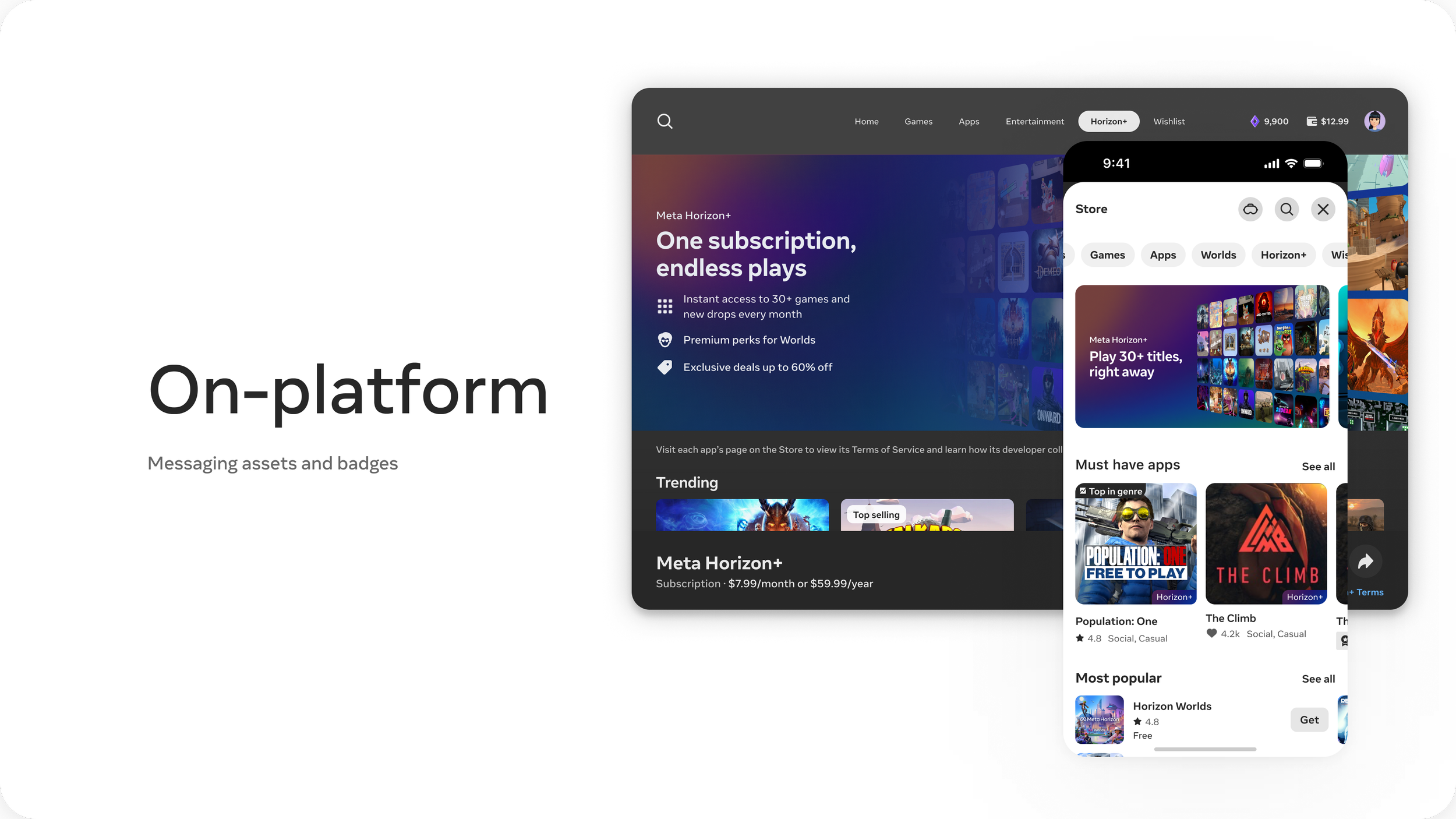
Driving design for Meta Horizon+ was among the most rewarding and strategically significant product initiatives during my tenure at Meta. As a primary VR revenue stream, Horizon+ presented a high-impact opportunity to grow both the program and its subscriber base. I led efforts that expanded the offering from just two monthly titles to a comprehensive catalog of benefits and experiences, contributing to a fourfold increase in subscribers to over one million active members.
My work spanned tactical campaign support and high-level platform changes: I influenced onboarding to introduce Horizon+ earlier in the user journey, secured placement in users’ libraries, and optimized core product surfaces to improve discoverability, conversion, and retention. These interventions collectively drove measurable growth and strengthened Horizon+ as a strategic business driver for Meta’s VR ecosystem.
Wallet, Checkout, and Payments
From the outset of my tenure at Meta, I led or co-designed payment experiences across Wallet, Checkout, and every associated payment flow. My initial project — in collaboration with a fellow designer — was the launch of Quest Cash, a digital balance and gift-card redemption system for Quest products. In its first year, Quest Cash facilitated over $5 million in transactions. I furthermore optimized our flows, streamlined our legal disclaimers, and standardized our UI patterns.
Timeframe
2023 - 2026
Role
Product Design VI
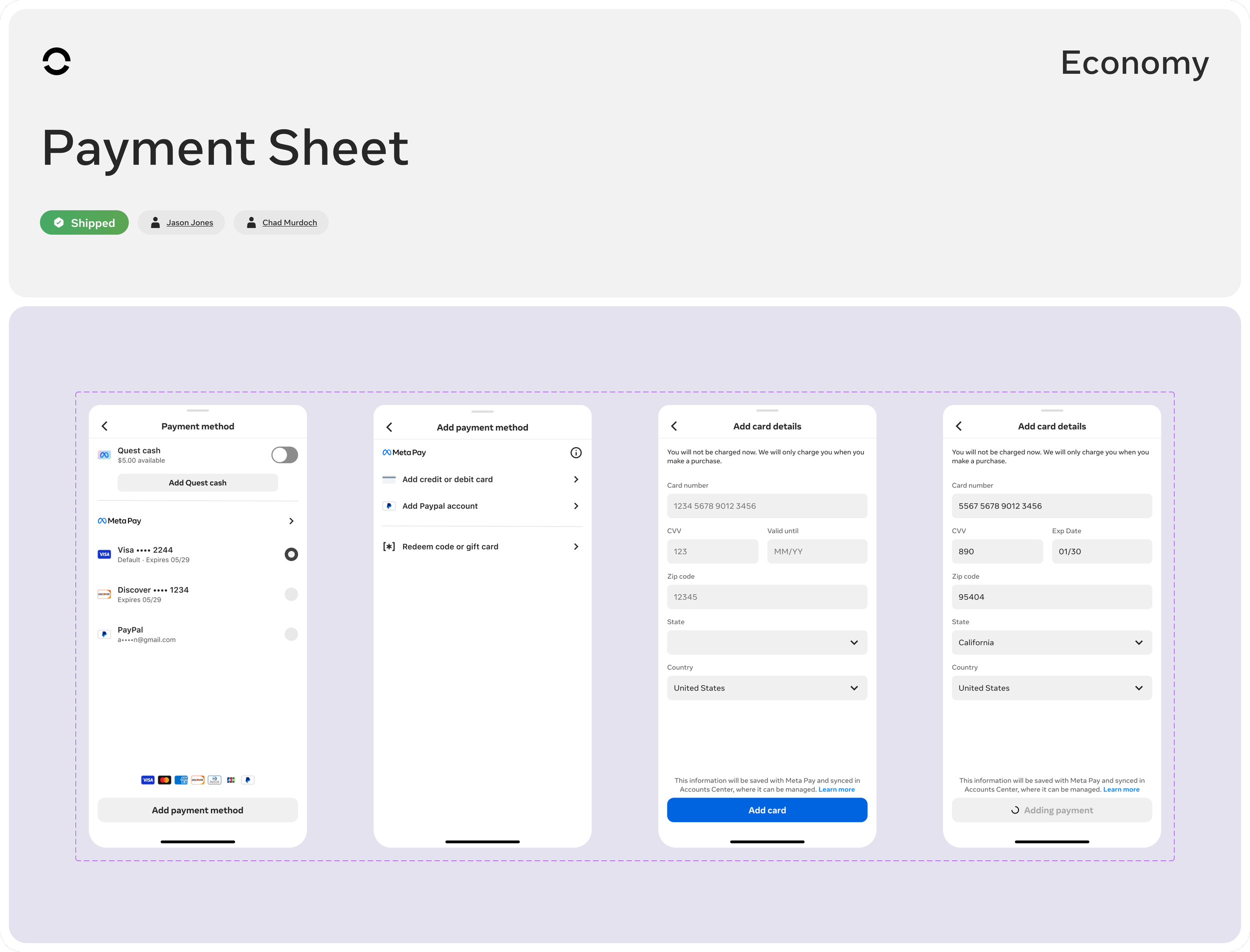
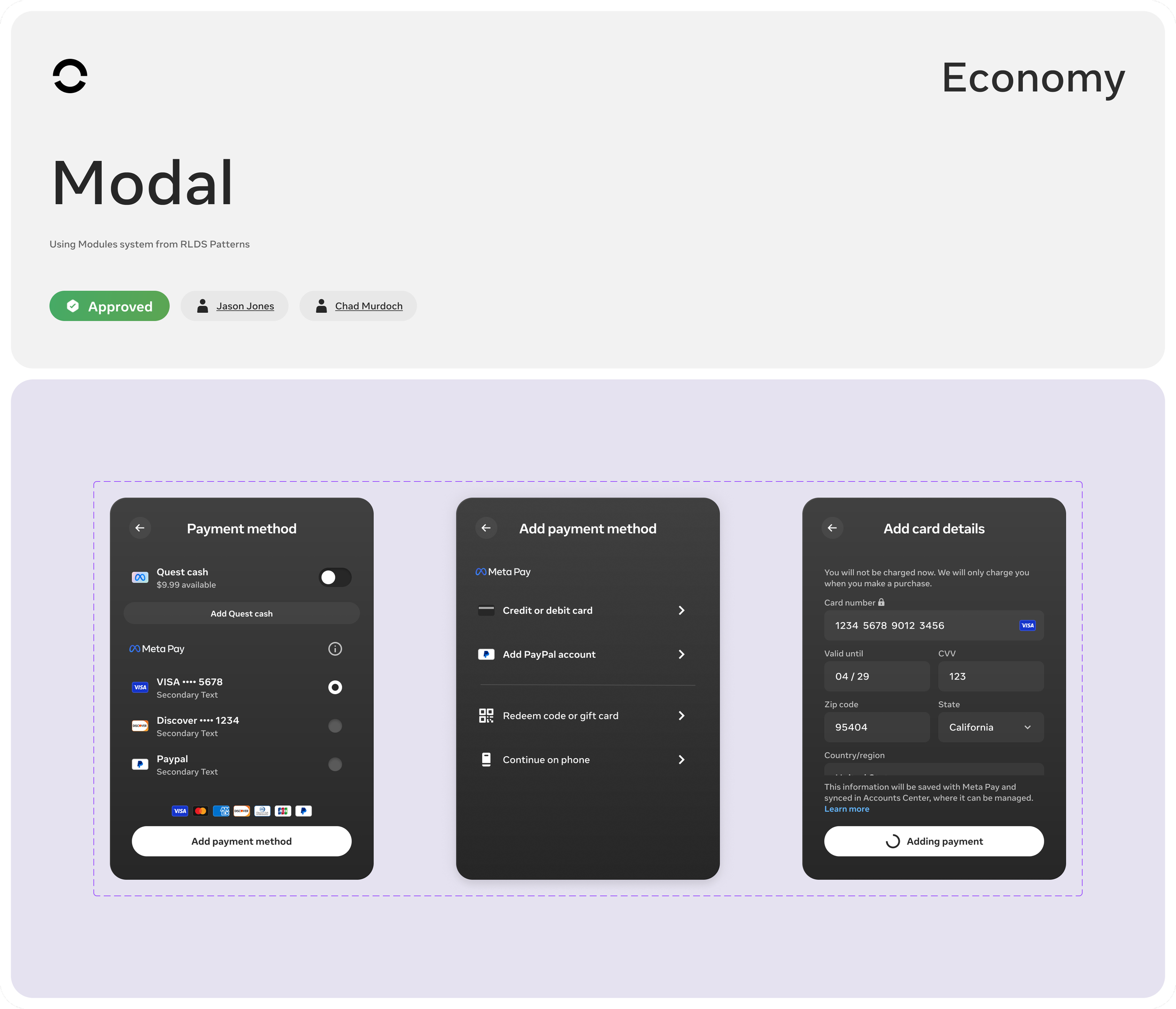
VR Wallet
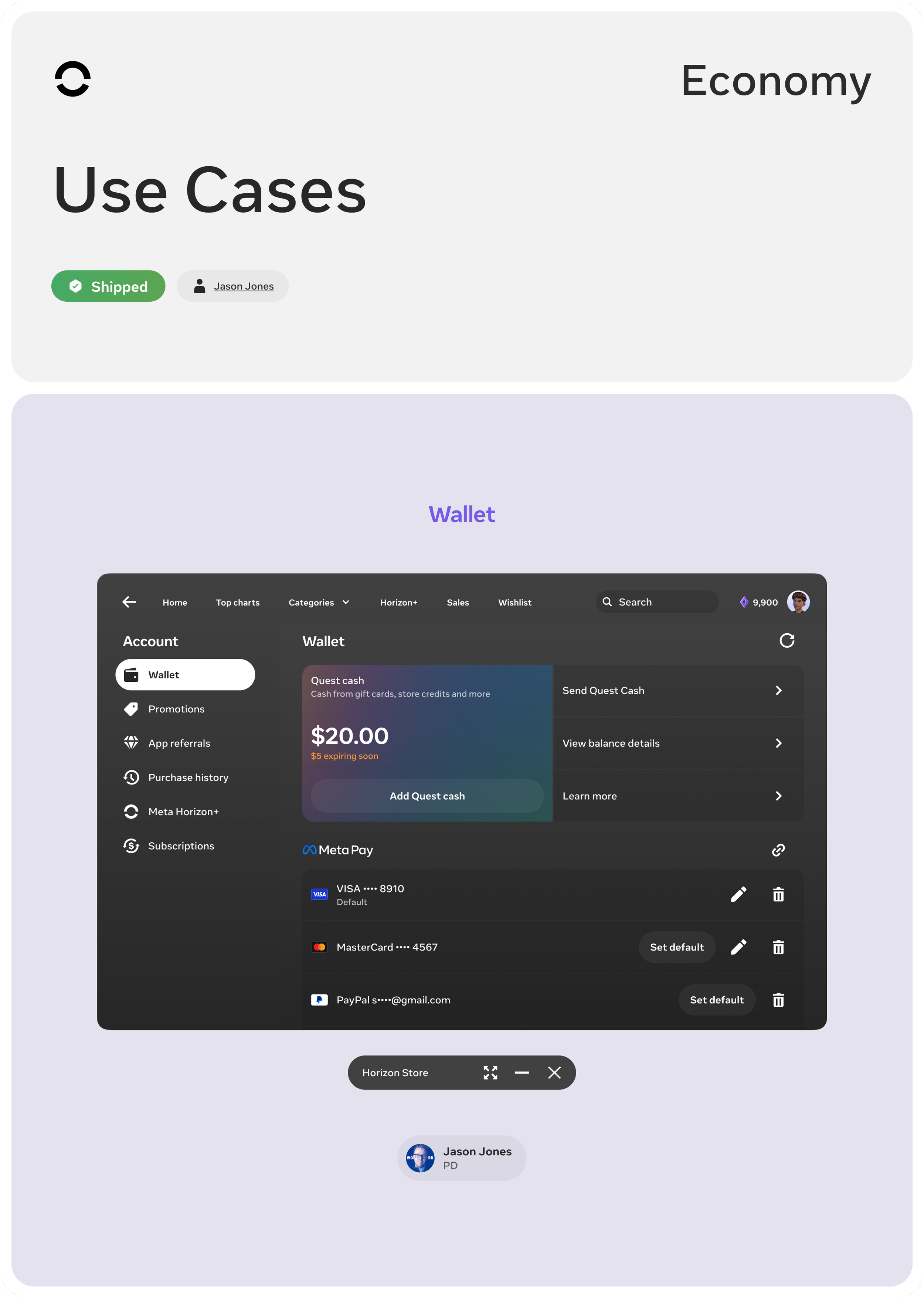
I overhauled the payment-method management flow, delivering a clearer, industry‑standard process for adding credit cards, PayPal accounts, and redeeming gift cards. I also led Checkout optimizations that simplified interactions—especially in VR—and developed a modular UI system to unify and scale Checkout across VR and mobile.
Add Payment
Quest Cash
Capture of production
Capture of production
Legal Collaboration Model
In late 2024 we faced an urgent legal-compliance update to satisfy regulatory requirements before year-end. That episode highlighted ongoing communication frictions between design and legal partners. While I rallied to implement the immediate changes, with my manager’s endorsement, I initiated a project in 2025 to formalize collaboration with legal.
Working closely with our legal team, I established a standard operating model for designers partnering with legal. The model introduced a shared compliance document, standardized templates and processes for designing compliant yet user-centered experiences, and a recurring office-hours cadence to ensure timely alignment and reduce last-minute escalations.
Checkout Compliance Optimization
The first outcome of this model was overhauling our Checkout terms tied to the confirmation button. It had become verbose and more complex than competitors’. I worked closely with design and legal to reach a compromise that condensed it from four lines to two and reduced five links to one.
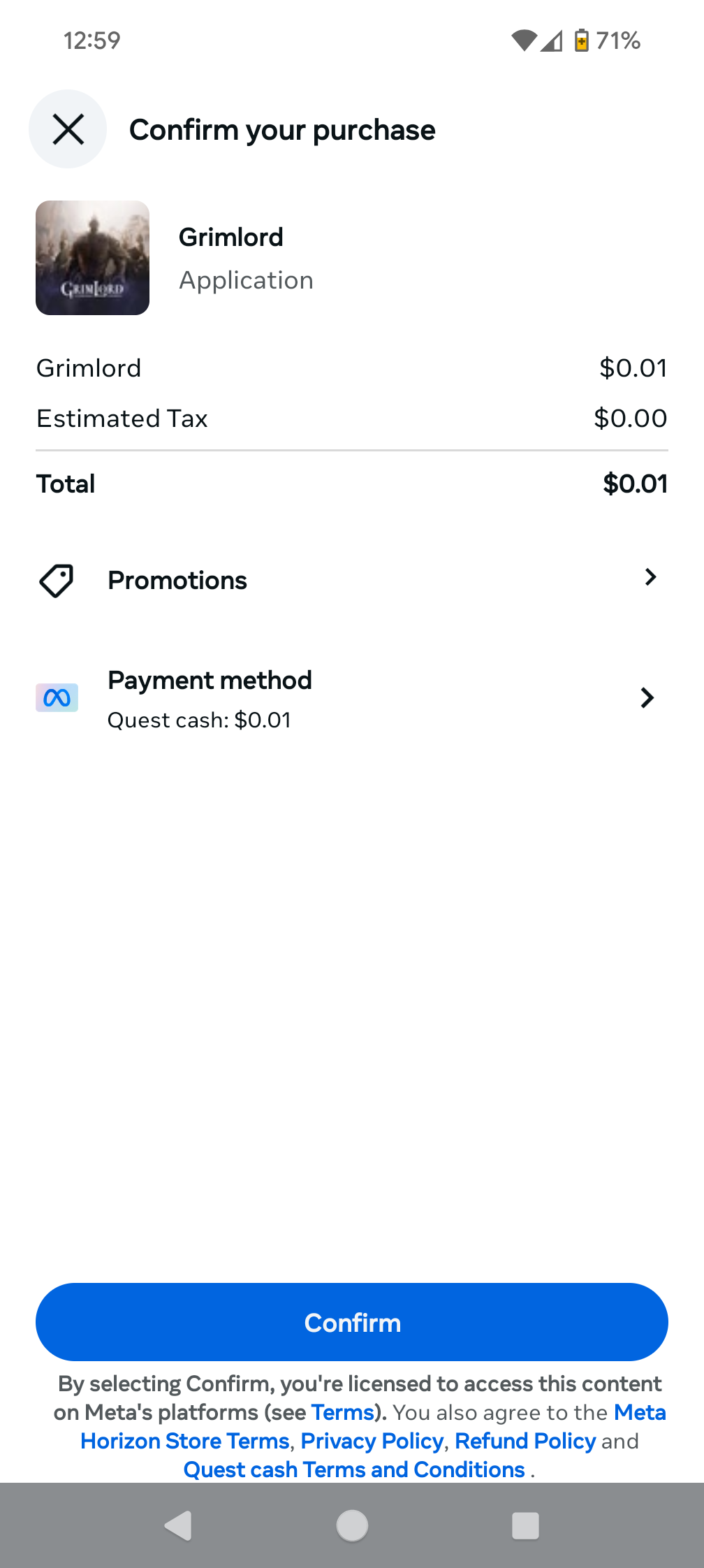
Consolidation of links into a sub-menu accessed through bottom sheet.
My background in ecommerce and retail positioned me to serve as a strategic leader on Meta Horizon’s payments experience. Leveraging industry knowledge and practical expertise, I quickly became the primary designer consulted by peers and cross-functional partners for payments and checkout initiatives. I led efforts to modernize an aging payments flow, driving the project to meet—and in some areas exceed—industry standards. My contributions reduced processing latency, rearchitected the UI for modularity, and removed unnecessary complexity, resulting in a leaner, more maintainable checkout experience.
Promotions Framework
When I joined Meta, the VR Store experience lacked an cohesive method for communicating promotions. Monetization partners over leveraged notifications to prompt users about active promos, and lacked any persistent path to discover promos within a users journey.
Timeframe
2023 - 2024
Role
Product Design VI
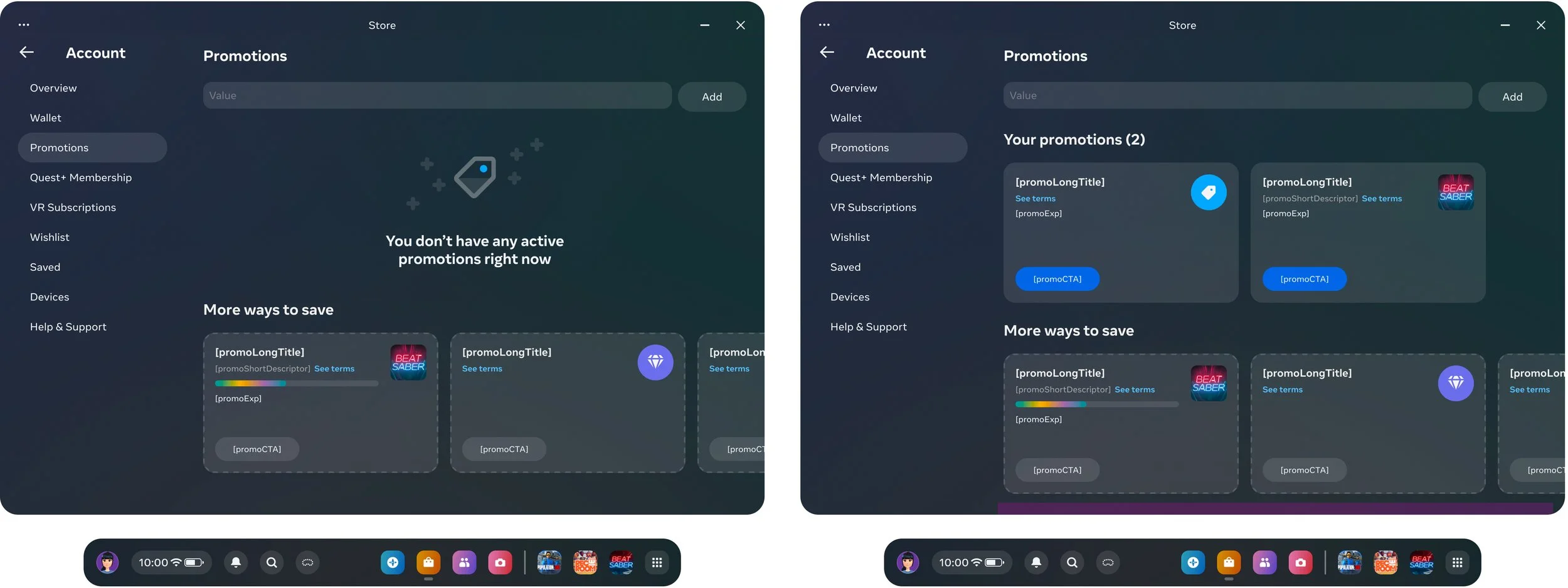
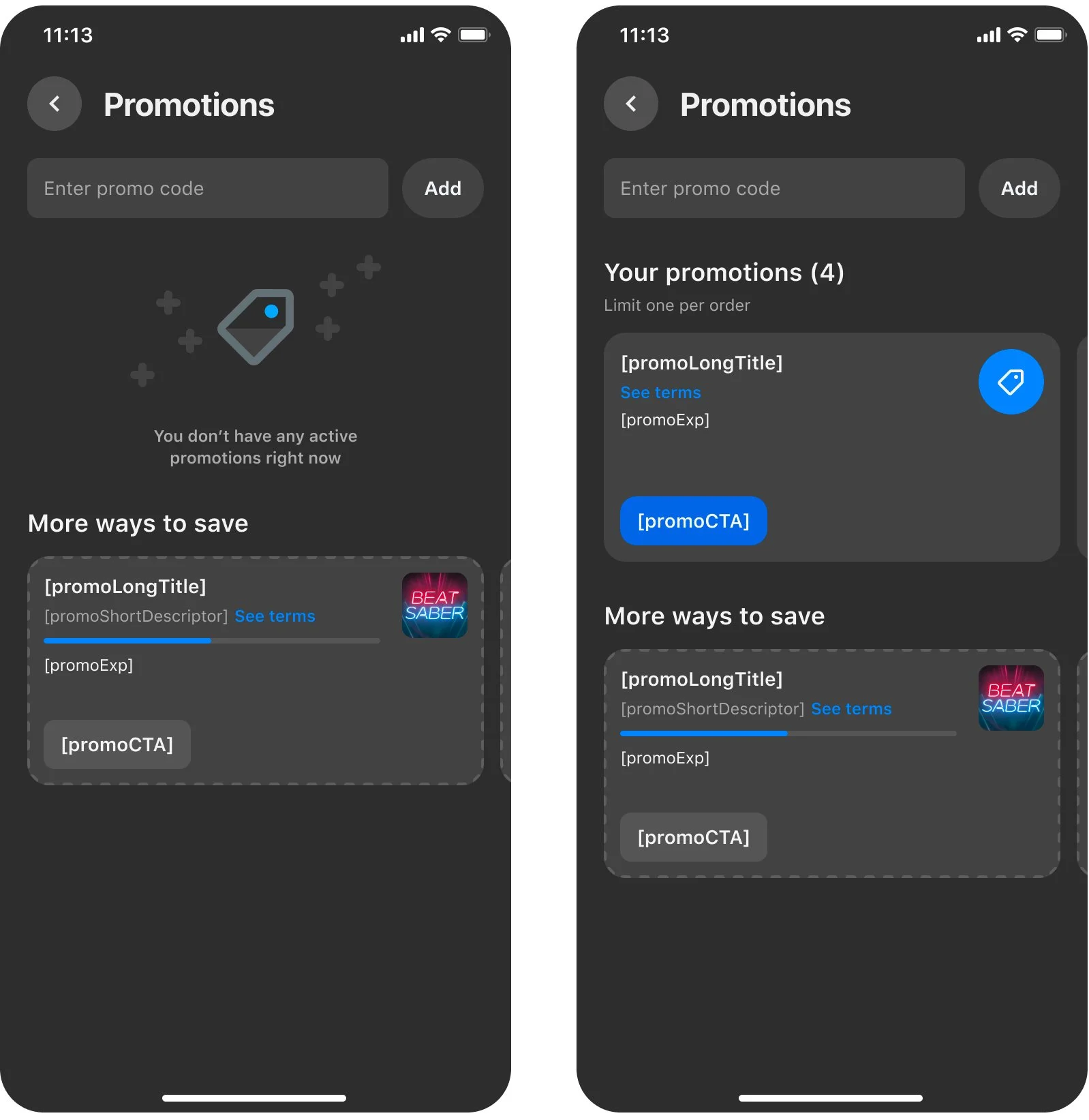
In partnership with a peer designer, I established a centralized promo hub across both our VR and mobile experiences. This gave users motivated to find discounts a place to discover, and use promos for content.
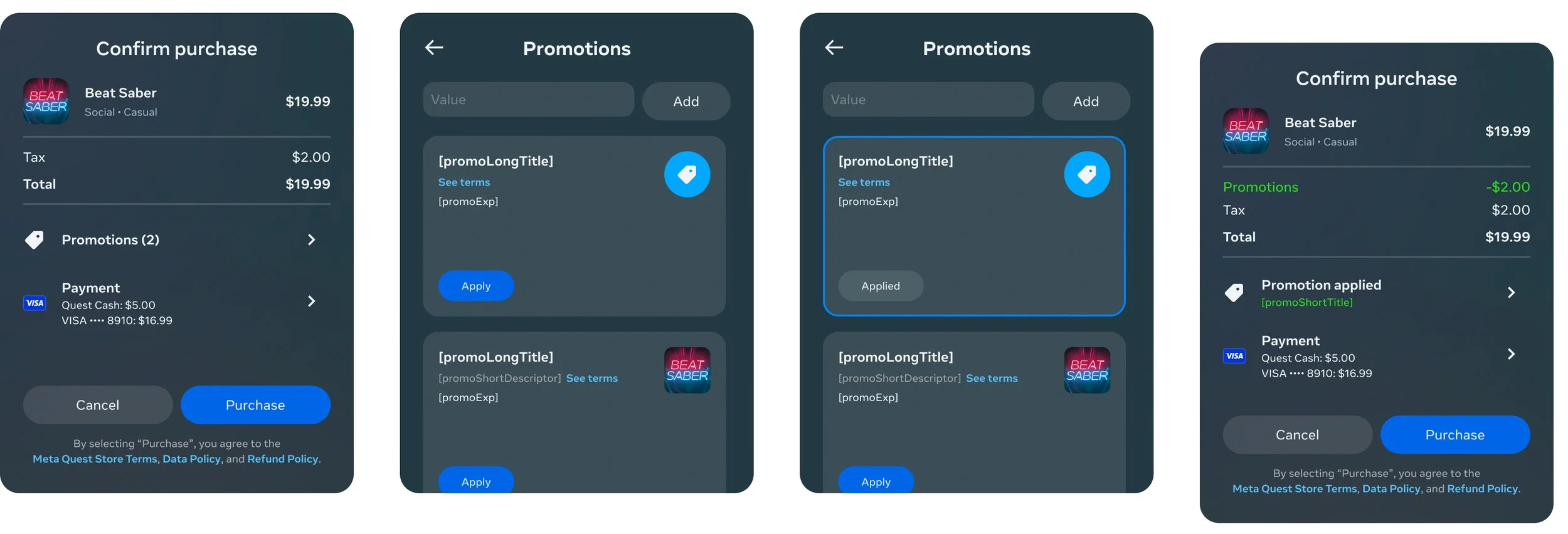
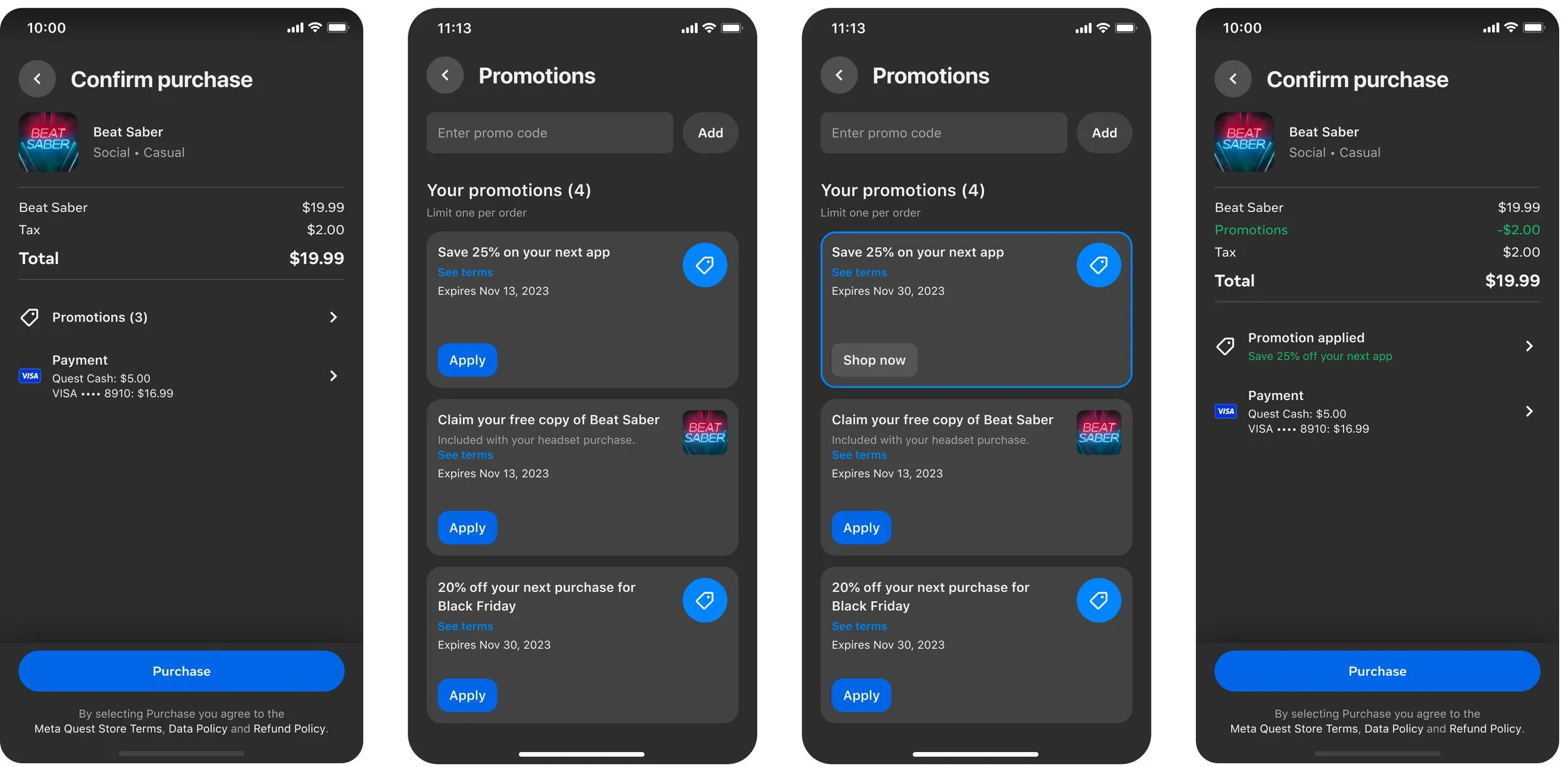
I completely redesigned the Promo redemption in the Purchase experience from a clunky inline code entry, to a clear promo selection view that enabled us to surface promos directly. I also coordinated with a Content Designer to establish promo content guidelines for phrasing standards, etc. We always lead with the savings “Save 25%…” etc.
I led multiple initiatives to design a cohesive promo discovery and redemption experience that now powers ongoing promotional campaigns. By applying a systematic approach, I persuaded engineering partners to fully re-architect the promo system, enabling discovery and redemption across diverse contexts and allowing us to meet customers at the right points in their journey.